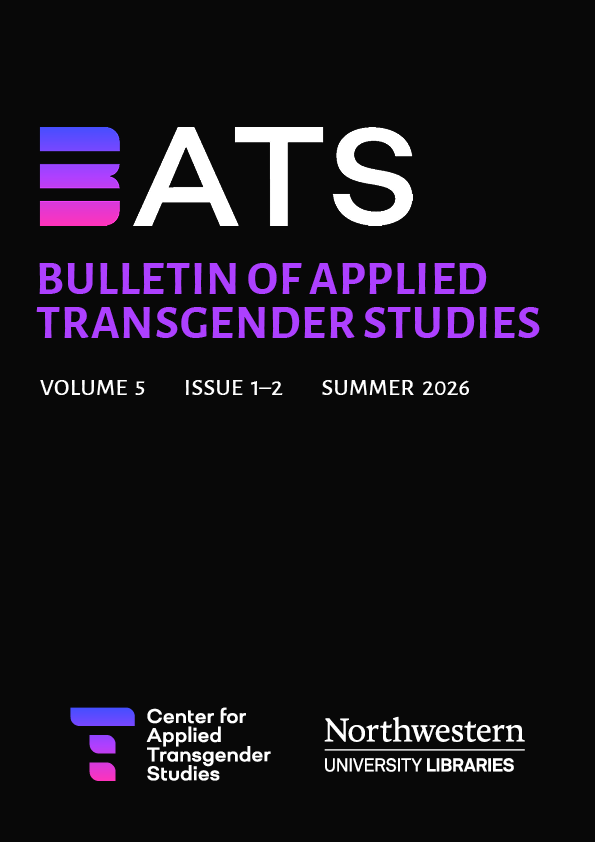
The Bulletin of Applied Transgender Studies (BATS) is the leading venue for academic research addressing the social, cultural, and political issues facing transgender and gender minority communities across the globe. The journal offers a platinum open access forum for research of all theoretical and methodological approaches oriented toward the identification, analysis, and improvement of the material conditions of transgender life.

Learn more

Volume 5, Issue 1-2


Cover of Current Issue

Volume 5, Issue 1-2

Summer 2026

ISSN 2769-2124

Download PDF

"I Have a Lot Working Against Me": Trans Precarious Labourers in Canada

Elliot Chudyk , Aaron Devor , Annalee Lepp

While we know that transgender people are not a monolith, the spectrum of labour precarity that exists for trans workers as well as the additional factors that lead some trans people into deeper levels of life precariousness remain understudied. In this article, we consider how employment precarity impacts trans peoples’ quality of life, and how trans peoples’ social and material conditions mediate their overall life precarity alongside their experiences of labour precarity. This article is based on 55 in-depth, semi-structured interviews, including 41 interviews with trans precarious workers and 14 with service providers who have worked with trans people experiencing precarious labour. Our analysis highlights participants embodied experiences of labour precarity and explores how varied positions of marginality and material barriers among trans people mediate the kinds of precarity they face. Examining participants’ recollections and personal narrations, we explored relationships among poverty, disability, migration, gender, and labour precarity as well as trans workers’ deployments of hope, agency, and resistance.

Original Article

Ignoring Transgender Pasts to Attack Trans Presents:: Politicised Heritage, Activism, and the Cass Review

Owen J. Hurcum , James Davison , Robert Girling , Dulcie Newbury , Ségdae Richardson-Read

This article provides a critical appraisal of the Cass Review from a heritage position through the lenses of archaeology, heresiology, myth, and literature. The paper introduces the framework of gender ahistoricism, and the authors highlight instances of gender ahistoric revisionism within the Cass Review’s final report*.* Further, they challenge these historical claims of gender through several case studies demonstrating a broader gender multiplicity than allowed for by the final report. This article, as well as furthering criticism of the Cass Review from these new heritage perspectives, also highlights the impact of gendered pasts more broadly on the material conditions of contemporary trans lives. It underpins and furthers the efforts that must be taken to ensure heritage practices and frameworks become tools of use, rather than oppression, for trans communities.

Original Article

It Is Hard to Believe You Are Real and Enough When the World Is Constantly Telling You That You Are Not: Understanding Nonbinary Impostor Phenomenon

Em Matsuno , Elster Mohr Jr , Alex E. Colson , Kiet D. Huynh , Kimberly F. Balsam

This qualitative study explores nonbinary impostor phenomenon (NIP), a phenomenon in which nonbinary individuals experience self-doubt about the validity of their gender identity. This study aimed to evaluate how nonbinary individuals define NIP and identify factors that influence NIP. To address these aims, we used reflexive thematic analysis and an intersectional lens to analyze data from 24 nonbinary adults who participated in either an individual interview or a focus group. Results showed that participants characterized NIP as internalizing the belief that being nonbinary is not real or that one is not nonbinary enough. These beliefs were accompanied by feelings of self-doubt, anxiety, and lack of belonging, indicating that NIP may be tied to worse mental health. Factors that contributed to NIP included binary normativity, nonbinary normativity, interpersonal invalidation, and misgendering. In contrast, factors that protected against NIP included community validation, interpersonal validation, and internalized validation. Identity development and concealment were also identified as individual factors that influenced NIP. Overall, these results underscore how NIP is a result of broader systems of normativity. Further research is needed on NIP and its mental health impacts.

Original Article

The Rise and Fall of "Tranny" in Australia

Noah Riseman

Language around gender diversity is constantly evolving. Terms that previously were markers of pride are now slurs, while other words coined by the medical profession and used for decades are now considered offensive. Yet, identity is something very personal, and there are many trans people who still self-identify with older terms. They are wary of younger trans people who may police identity, exacerbating a perceived generation gap among trans people. Trans debates over language are less about reclaiming slurs, and more about what happens when previously acceptable words go out of fashion and become offensive. This article explores some of the changing terminology involving trans people in Australia. Drawing on oral history interviews, observations, interactions, media, and archival records, it focuses especially on the word “tranny.” That term is now considered one of the most offensive words someone can call a trans person. In the 1990s, though, the word was a marker of pride, and one which some older trans people continue to use. This article explores the changing position of “tranny” and other words within the trans community. It poses some reflections about how the loss of historical context hinders communication across generations.

Original Article