Navigating Parental Rejection and Forging a Path to Acceptance
The Experiences of the Transgender Community in China
F. Virago
Parental rejection poses a major challenge for transgender individuals; however, the reasons behind this rejection remain critically understudied, especially within the Chinese sociocultural context. Using a mixed-methods approach, this study investigates parental rejection as experienced by the transgender population in China by analyzing quantitative survey data (N = 199) and qualitative interviews (N = 32) to document rates of parental support, identify key reasons for rejection, and explore factors that facilitate acceptance. Over 75% of participants reported that both their mothers and fathers were unsupportive when they first came out as transgender, with the belief that being transgender is “unnatural” (71%) and the fear of losing face (67%) cited as the two most prevalent reasons for this rejection. However, a significant proportion of parents eventually moved towards acceptance, with 43% of mothers and 34% of fathers showing an increase in support after the initial disclosure. According to participants, this increase in acceptance was motivated by parental love, concern over the participant’s mental health, and the participant’s transition. They reported that parents then utilized three pathways to understanding their transgender identity: consumption of informational resources, engagement with the queer community, and guidance from medical professionals. Understanding why parents reject their transgender children is the first step towards promoting acceptance both within the family and in society as a whole.
- Volume (Issue)
- 4(4)
- Published
- December 15, 2025
- DOI
- 10.57814/x87b-as17
- Copyright
- © 2025. The Authors. This is an open access article distributed under the terms of the Creative Commons Attribution-NonCommercial-NoDerivatives 4.0 International License (CC BY-NC-ND 4.0)
- Preferred Citation
- Virago, F.. 2025. "Navigating Parental Rejection and Forging a Path to Acceptance: The Experiences of the Transgender Community in China." Bulletin of Applied Transgender Studies 4 (4): 319-346. https://doi.org/10.57814/x87b-as17
Around the age of four or five, when I began to develop a sense of gender, I realized that I “should” be a boy, even though I was born with a female body. I felt like I was carrying a secret that I couldn't tell anyone, including my parents. I felt so confused and unsettled, I did not understand what was happening. The only clear thing was—I was a boy.
–Hongrui, a trans man born in 1989
Hongrui was born in 1989 in a rural village in southern China, where he quickly realized he was a transgender man, but, being in rural China, he did not have access to any information about this topic. It was not until he moved to an urban area for college that he finally found the words to describe his identity. In 2010, at age 21, Hongrui shared these feelings with his parents, but they completely rejected his gender identity. His mother was so angry she refused to speak, and his father cried in secret. Hongrui’s parents argued that being transgender was “unnatural” (有违自然, yǒu wéi zìrán), and claimed he was just going through a phase. They feared their child would face a life of discrimination for defying societal norms. Hongrui’s parents had lived their whole lives in rural China; being transgender was unheard of for them. It took a full decade for Hongrui’s parents to come to terms with his identity. During this time, they were motivated by their love for their son to seek out informational resources and connect with the queer community to understand what it means to be transgender. Now, Hongrui’s parents are very supportive of his gender identity, and they have a close, loving relationship.
Research has shown that Chinese parents are overwhelmingly unsupportive of their transgender children, especially when they first come out (K. Chan et al. 2024; Wu et al. 2017), but why? At present, few studies have attempted to document what reasons parents, Chinese or not, have for rejecting their child’s gender identity. Furthermore, while some studies of the western transgender population have begun to document how and why parental views change after their child initially comes out, researchers have yet to examine this question in China. Thus, this study works with transgender individuals to document the rates at which their parents support or reject their gender identity while also identifying what reasoning their parents base this rejection on. Participants also detail which methods they have used to influence their parents into becoming supportive of their transgender identity. This study used a mixed methods approach and gathered quantitative data through a survey of 199 transgender individuals in China and qualitative data from 32 interviewees of this survey. The sample for this study is largely young (72% aged 18–25), well-educated (59% have a bachelor’s degree), and urban (83% grew up in urban areas). A mixed-methods approach was used to provide a platform for the Chinese transgender community to share their voices with the world. Only by understanding why parents reject their children’s transgender identity can we address this lack of support and guide them towards acceptance.
Background
Gendered expectations in China
Defying the expectations placed on you in accordance with your sex assigned at birth is more than a matter of personal expression in China where the state itself has stepped in to regulate gender presentations. In 2021, a proposal was put forth at the National People’s Congress entitled “Preventing the Feminization of Male Adolescents,” which accused male adolescents in China of being too soft and weak, while calling for a national effort to cultivate masculinity by increasing physical education in schools (Ministry of Education of the People’s Republic of China 2021). Later that year, a directive from the National Radio and Television Administration effectively banned the broadcast of effeminate men, whom they referred to as “sissies” (娘炮, niáng pào), claiming that such “abnormal” individuals are a threat to the nation’s culture (Central People’s Government of the People’s Republic of China 2021). 娘炮 is a derogatory term used to target any man not in compliance with traditional notions of masculinity but has been especially used to attack queer individuals (Wang and Bao 2023). Research confirms that avoiding femininity is a defining feature of masculine expectations in China (Song and Liang 2018). Failure to comply with these standards results in severe bullying and is potentially fatal, as was the case for 26-year-old Zhou Peng, who committed suicide only months after effeminate men were banned from TV (Yip 2021).
Gender expectations for women in China have experienced whiplash from the masculinized ideal woman of Mao Zedong’s Cultural Revolution to the hyper-femininity of present-day China. During the Cultural Revolution (1966 to 1976), Mao sought to expand China’s working population as well as his army of supporters by raising up women to be equal to men, as long as they chopped off their hair, donned men’s clothes, and took up hard labor jobs (M. Yang 1999). After Mao’s death, China opened its doors to the world again and women were promptly shoved back into the box of traditional femininity, where women in China are now held to extreme beauty standards and are hypersexualized in media (W. Yang and Yan 2017). Currently, the beauty standard for women in China is pale, young, and thin (Liu and Li 2023), and marriage is considered the pinnacle of a woman’s life as unmarried women in their late 20s are labeled as “leftover women” (剩女, sheng nǚ) (Gui 2020). Women in Chinese movies are significantly more likely than the male characters to be young, sexualized, and in conformity with stereotypical beauty standards (Liebler et al. 2015). In the real world, women who comply with these beauty standards receive a greater income than those who defy these norms (Hamermesh et al. 2002). These standards of hypermasculinity and hyperfemininity reveal that there is little room for gender nonconformity in modern day China, placing transgender individuals at great risk of societal exclusion and discrimination.
The reality of being transgender in China
Despite being ignored in mainstream history and media, Chinese records reveal that transgender men and women existed openly throughout both the Ming Dynasty (1368–1644) and the Qing Dynasty (1644–1911) (Xie 2017). Today, an estimated 4.2 million trans people live in China, but, aside from one notable celebrity, there is no representation or discussion of trans Chinese people in mainstream media (Feng 2022). China’s singular trans celebrity is renowned ballerina and talk-show host Jin Xing (金星), who underwent gender affirming surgery in 1995. However, despite Jin Xing’s fame and influence, her trans identity is rarely discussed, and she has refused to use her position to advocate for LGBTQI+ rights in China, stating that queer people should not expect “special treatment” and must instead work hard to “earn” their basic human rights (J. Dong 2021). This lack of media representation is a critical barrier to achieving societal acceptance as positive portrayals of transgender people increases acceptance amongst non-LGBTQI+ people (Gay & Lesbian Alliance Against Defamation 2025; Gillig et al. 2017). In China’s current media environment, this vital representation is essentially nonexistent.
Gaining parental acceptance as a trans person in China is particularly important due to the government’s requirements for transitioning, the legal obligations regarding elder care, and the positive influence of parental support on mental health. In China, the government requires individuals to obtain parental consent before undergoing bottom surgery (gender-affirming genital surgery) regardless of age. Although parental consent is technically only a requirement for bottom surgery, many practitioners also enforce this rule on patients seeking hormone replace therapy (HRT) and other gender-affirming operations (X. Zhou 2024). Due to this often-insurmountable obstacle, a large portion of the trans community in China must resign to buying HRT medications off the black market or even using unrelated medications in hopes of achieving the effects of HRT (Amnesty International 2019). For example, many trans women will take birth control or fertility treatments as substitutes for estrogen. The effects of taking unprescribed medications is dangerous and can result in severe, life-long health problems.
Trans people in China with unaccepting parents face further battles due to the expectations of filial piety, which mandate that children must care for their parents in old age (Y. Yang 2021). The essence of filial piety is to be respectful and obedient to your parents in repayment for bestowing life upon you, and this 3,000-year-old Confucian belief continues to inform familial relationships to this day (Guo 2008). The key aspect of modern filial piety is caring for your parents in old age by financially supporting them, moving in with them, or allowing them to move into your own home (Y. Yang 2021). This societal expectation became mandated by the government in 2013 when a law passed by the National People’s Congress allowed parents 60 and older to sue their children if they neglected to provide the culturally expected support. Similarly, in 2016, the Shanghai Ministry of Civil Affairs instated a policy to punish neglectful children by publicly posting their names and docking their credit score (X. Dong 2016). These policies permanently tie individuals to their parents, placing transgender individuals in a precarious situation by forcing them to maintain relationships with unaccepting parents to avoid legal consequences.
The effects of parental acceptance go beyond merely facilitating medical transitions and easing elder care; parental support is lifesaving. Several studies have found that parental acceptance improves adolescent transgender mental health and leads to decreased rates of suicidal ideation (Jin et al. 2020; Hingston 2019; Simons et al. 2014). Addressing suicide rates within the Chinese trans community is imperative as researchers have found it to be exponentially higher than that of the cisgender population; only 12% of the cisgender population in China experiences suicidal ideation, compared with 56% of the trans community. Suicide attempts occur in only 3% of cisgender individuals versus 16% of transgender people (Chen et al. 2019). Since parental acceptance decreases the risk of suicide among transgender people, there is a clear need to understand why parents reject their transgender children.
Current Research on Parental Support of Transgender Identities
The lack of knowledge in China on transgender people contributes to the widespread rejection of transgender identities. Research has found that Chinese parents are largely uninformed on this topic, leading them to fall for common misconceptions regarding trans people (Lin 2018; Song and Chen 2022). A study of the transgender population in China found that nearly 90% of participants reported that their natal families did not fully accept their gender identity (Wu et al. 2017). Sixty-five percent of the respondents interested in gender-affirming surgery disclosed that their parents barred them from pursuing it. A continuation of this study, published in 2023, found that only 19% of participants’ mothers were very or somewhat supportive of their gender identity compared with just 11% of fathers (Beijing LGBT+ 2023). Higher rates of maternal acceptance in comparison with paternal acceptance has been found in several other studies (Hill and Menvielle 2009; Ishii 2017; Riggs and Due 2014; Y. Zhou et al. 2021).
At present, no research quantitatively measures parental reasoning for rejecting transgender identities, but some studies have indirectly documented various reasons for rejection. Five reasons have been noted both within and outside of China: the fear of losing face (Song and Chen 2022), the fear that their child will face discrimination (Hill and Menvielle 2009; Song and Chen 2022), the belief that being trans is unnatural (Lin 2018), the belief that it is just a phase (Gray et al. 2015; Gregor et al. 2014; Hill and Menvielle 2009; Ishii 2017; Johnson et al. 2020; Katz-Wise et al. 2017; Lin 2018), and the claim that this is a symptom of westernization (Johnson et al. 2020). Additionally, trans women in China have been documented as being rejected on the basis that they were expected to carry on the family name (Song and Chen 2022; Yan et al. 2019).
Researchers have examined three specific routes parents take to reaching acceptance: consuming informational resources (Hill and Menvielle 2009; Ishii 2017; Johnson et al. 2020), connecting with the queer community (Ishii 2017), and receiving guidance from medical professionals (Gray et al. 2015; Riggs and Due 2015). Three motivations behind this change have also been documented: unconditional love (Hill and Menvielle 2009), the child’s persistent transition (Sansfaçon et al. 2015), and the mental health of the child (Amnesty International 2019).
Although the studies covered in this section do provide a helpful foundation for this study, they suffer from some major limitations as only a few focus on China specifically and, those that do, have small sample sizes. There are additional studies and essays that provide ethnographic and autobiographical insight into this population, but these also lack a robust sample size (Jun 2010).
With this research and background in mind, this study puts forth the following research questions:
RQ1: What difference do transgender individuals in China perceive in the acceptance of their gender identity between their mothers and fathers?
RQ2: What are the specific reasons Chinese parents use to reject their children’s gender identity?
RQ3: What motivations and processes facilitate a parent’s shift from rejecting to accepting their child’s gender identity?
Methods
Definitions
Transgender is an umbrella term that applies to any individual who does not identify with their sex assigned at birth, including binary trans people and nonbinary trans people. Binary trans people are those who identify with a binary gender identity, e.g. man or woman. Nonbinary trans people includes a range of different terms, the most prominent being agender and genderfluid. Agender is defined as someone who has no gender, and genderfluid is someone who moves between two or more gender identities. Transfeminine nonbinary people, both agender and genderfluid, are those who were assigned male at birth, and transmasculine refers to those who were assigned female at birth. A cisgender person is someone who identifies with their sex assigned at birth.
Mixed Methods Structure
This study consisted of two integrated phases in accordance with an explanatory sequential mixed methods design (Creswell and Creswell 2018), where the quantitative survey (N = 199) was conducted first to identify patterns, and then followed by interviews (N = 32) to extend the analysis by incorporating qualitative data. The results from the survey informed the purposeful selection of interviewees as well as the interview questions (Creswell and Creswell 2018). Interviewees were chosen based on age, gender, and parental level of support to build a representative sample of the survey population. Through the utilization of the explanatory sequential mixed methods design, this study uses its qualitative findings to enrich the quantitative survey data by revealing the lived experiences behind the statistics.
Population Selection Justification
This study exclusively examines transgender participants’ perspectives on parental acceptance/rejection and emphasizes that all interpretations of parental motivations are necessarily mediated through the participant’s experience. The decision to collect data from transgender individuals rather than their parents was methodological and based on previous research: (1) unsupportive parents were unlikely to participate in research about gender identity, creating potential for non-response bias; (2) parents may retrospectively minimize past conflicts with their children due to social desirability effects such as shame or memory reconstruction (R. Chan 2011); and (3) it is difficult to gain access to parents of transgender individuals as a population in China. As a result, the following parental motivations should be viewed as participant-reported attributions rather than definitive parental perspectives. Recommendations for future research incorporating parents can be found at the end of the article.
Quantitative Data Collection
Participants were recruited via several LGBTQI+ organizations throughout China as the author shared their research invitation in the WeChat group chats for these organizations. Since the topic of this study is particularly sensitive in China, the research invitation was only posted in group chats, not on any website. As a result, the survey’s sample population is limited to people who are active in the queer community. Furthermore, snowball sampling was used for the survey instead of random sampling due to the difficulty in accessing this community.
The research invitation included information about the research study, the researcher, and a QR code that linked to the research survey. This survey was created with the Chinese survey website Wenjuanxing (问卷星) and was written in Chinese. To partake in this study, participants had to be: (1) transgender, (2) of Chinese ethnicity, and (3) born and raised in China. Those under the age of 18 were permitted to participate in the survey but were not allowed to be interviewed, in accordance with IRB requirements. The survey was published on 11 April 2023 and closed on 15 June 2023. A total of 200 responses were received during this period, however, one response was excluded from analysis as the respondent stated that they did not grow up in China. The resulting sample size for the survey totaled at 199 respondents. Table 1 shows the detailed demographics for the survey sample.
| Variable | n | % |
|---|---|---|
| Gender | ||
|
Trans women |
87 | 43.72% |
|
Trans men |
73 | 36.68% |
|
Agender |
32 | 16.08% |
|
Genderfluid |
7 | 3.52% |
| Sex Assigned At Birth | ||
|
Female |
96 | 48.24% |
|
Male |
103 | 51.76% |
|
Intersex |
0 | 0% |
| Level of Education | ||
|
Middle school |
13 | 6.53% |
|
High school |
26 | 13.07% |
|
Associate degree |
20 | 10.05% |
|
Undergraduate degree |
117 | 58.79% |
|
Master’s degree |
19 | 9.55% |
|
Doctoral degree |
4 | 2.01% |
| Age | ||
|
Under 18 |
20 | 10.05% |
|
18–25 |
143 | 71.86% |
|
26–30 |
26 | 13.07% |
|
31–40 |
9 | 4.52% |
|
41–50 |
0 | 0% |
|
51–60 |
1 | 0.50% |
|
61+ |
0 | 0% |
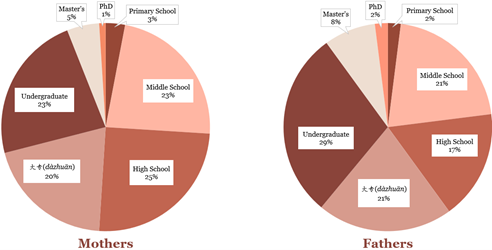
Although the sample population does include diversity in terms of age and education, the majority were young, well-educated, and grew up in urban areas, with 72% falling between 18-25 years of age and 59% of the sample already having obtained an undergraduate degree. In terms of upbringing, 83% of respondents grew up in urban areas, while 17% were raised in rural villages. Currently, 94% of participants reside in urban areas of China, with the remaining 6% living in rural regions. Since this study focuses on parental reception of transgender identities, participants were also surveyed on their parents’ upbringing and education and reported that 62% of both mothers and fathers were raised in urban areas while 38% grew up in rural areas. As for education, 51% of respondents reported that their mother’s highest level of education was high school or less. Fathers received more education, with only 40% of fathers in this group. The chart below shows a detailed breakdown of parental education by gender. Note that 大专 (dàzhuān) does not have an exact equivalent in the US; it is a post high school diploma program that usually lasts two to three years.
To measure parental support and rejection, participants were asked “When you first came out to your parents, did they support your transgender identity?” This question included a row for their mother and a separate row for their father. Participants’ options for selection were “very unsupportive,” “unsupportive,” “neutral,” “supportive,” and “very supportive.” Following this question, participants were asked “After coming out, did your parents opinion or attitude change?” If the respondent selected “yes,” they were then asked, “At present, do your parents support your transgender identity?” The same options were provided as the previous question on parental support. If participants indicated that either their mother or father were unsupportive, a question was triggered for the relevant parent to measure their reasoning for rejection. This question was multiple selection, and the options were “unnatural,” “afraid of losing face,” “believes it is just a phase,” “received negative influence online,” “afraid child will face discrimination,” “westernized,” and “religion.” An open response option labeled as “other” was also available for respondents to add any additional reasons for rejection.
In line with sex-based gendered expectations, transgender women and transfeminine nonbinary participants were given an additional question about carrying on the family name since both groups were assigned male at birth. This question surveyed whether their parents rejected them because they had expected them to “carry on the family name” (传宗接代, chuán zōng jiē dài). This question differed slightly from the above as it surveyed current parental views, instead of their initial reaction. Thus, participants were given three response options: “yes,” “no,” and “already supportive.” Mothers and fathers were surveyed separately.
Qualitative Data Collection
At the end of the survey, participants were given the option to express interest in being interviewed. Purposeful sampling was used for selecting interviewees to ensure the resulting sample properly represented the survey sample regarding three factors: age, gender, and level of parental support (Creswell and Creswell 2018). The sample size for interviews totaled at 32; 11 transgender women were interviewed as were 11 transgender men. 10 agender and genderfluid people were interviewed, with an equal balance of sex assigned at birth. Interviews were semi-structured and covered the same topics as the survey. The interviews were conducted with two main goals: obtain a clear life picture from the interviewee and answer any questions that arose based on their survey responses. The author is bilingual and conducted 30 of the interviews in Chinese, while the remaining two were done in English due to participant preference. Quotes used in this article from interviews conducted in Chinese were translated into English by the author. Interviews ranged from 30 minutes to two hours, with most lasting around one hour. Interviews were conducted between June 18th, 2023 and July 31st, 2023. 11 interviewees were contacted via WeChat messaging with follow-up questions. Tables 2 and 3 show the pseudonym, levels of initial and current parental support by parent (M = mother, F = father), and year of birth for each interviewee. Initial parental support precedes current support. Table 3 contains information for nonbinary individuals and thus also includes an additional section for their specific gender identity under the nonbinary umbrella category. While each interviewee was included in the overall qualitative analysis, not every interviewee was directly mentioned as an example in this study and thus not all have pseudonyms.
This research study was funded by Peking University’s Dean’s Research Grant. These funds were used to provide each interviewee with 50 RMB as compensation for their time. Survey respondents did not receive compensation. This study was approved by the Institutional Review Board of Peking University’s Sociology Department, and each interviewee signed an informed consent form.
| Pseudonym | Gender | Level of Parental Support | Year of Birth |
|---|---|---|---|
| N/A | Trans woman | M: Initially unsupportive; Now very supportive F: Initially unsupportive; Now supportive |
2005 |
| N/A | Trans woman | Both: Very unsupportive | 1997 |
| Yuting | Trans woman | Both: Initially unsupportive; Now supportive | 1997 |
| Ruoyu | Trans woman | Both: Initially supportive; Now very supportive | 1998 |
| Xinlei | Trans woman | Both: Very unsupportive | 2002 |
| Mengjie | Trans woman | Both: Very unsupportive | 1969 |
| N/A | Trans woman | M: Initially unsupportive; Now supportive F: Initially very unsupportive; Now neutral |
1998 |
| Shinan | Trans woman | M: Very unsupportive F: Initially very unsupportive; Now neutral |
2003 |
| Yaqi | Trans woman | M: Initially very unsupportive; Now very supportive F: Initially very unsupportive; Now supportive |
1990 |
| N/A | Trans woman | Both: Very unsupportive | 1995 |
| Yuhua | Trans woman | Both: Very unsupportive | 1992 |
| Yize | Trans man | Both: Very unsupportive | 1998 |
| N/A | Trans man | M: Very unsupportive F: Initially unsupportive; Now neutral |
2001 |
| Junxi | Trans man | M: Initially neutral; Now supportive F: Supportive |
1993 |
| N/A | Trans man | M: Initially neutral; Now supportive F: Very unsupportive |
1996 |
| N/A | Trans man | Both: Very unsupportive | 2002 |
| Zihua | Trans man | M: Initially very unsupportive; Now neutral F: Very unsupportive |
2002 |
| Hongrui | Trans man | Both: Initially very unsupportive; Now very supportive | 1989 |
| Taizhe | Trans man | M: Very unsupportive F: Initially very unsupportive; Now supportive |
2001 |
| Zeqing | Trans man | Both: Initially unsupportive; Now supportive | 2001 |
| Baicheng | Trans man | M: Initially unsupportive; Now supportive F: Initially very unsupportive; Now supportive |
1998 |
| N/A | Trans man | M: Initially unsupportive; Now very supportive F: Initially unsupportive; Now supportive |
1994 |
| Pseudonym | Gender | Level of Parental Support | Year of Birth |
|---|---|---|---|
| N/A | Transmasculine genderfluid | M: Initially unsupportive; Now supportive F: Very unsupportive |
2001 |
| N/A | Transmasculine agender | Both: Unsupportive | 1998 |
| N/A | Transmasculine agender | M: Unsupportive F: Very unsupportive |
2000 |
| Tingsheng | Transmasculine agender | Both: Unsupportive | 2003 |
| Youran | Transmasculine agender | M: Initially unsupportive; Now neutral F: Initially neutral; Now supportive |
1992 |
| Chenyang | Transfeminine genderfluid | M: Initially neutral; Now very supportive F: Very unsupportive |
2004 |
| N/A | Transfeminine agender | M: Very unsupportive F: Unsupportive |
2004 |
| Ruijuan | Transfeminine genderfluid | Both: Initially neutral; Now very supportive | 1999 |
| N/A | Transfeminine agender | M: Initially unsupportive; Now neutral F: Very unsupportive |
2003 |
| N/A | Transfeminine genderqueer | M: Unsupportive F: Very unsupportive |
2001 |
Quantitative Analysis
The website used for the survey, Wenjuanxing, was used to generate the percentages discussed throughout this study. Wenjuanxing has extensive tools for quantitative analysis and allows the user to filter based on different responses. Using this tool, the author grouped survey respondents on different attributes, namely gender, to compare their answers. One-tailed hypothesis testing was conducted using a z-score calculator for two population proportions to analyze parental support and reasons for rejection. One-tailed hypothesis testing was chosen as the study’s hypotheses were directional, based on prior research and preliminary observations. This method was first used to examine the differences in rates of support for mothers and fathers, including both initial support as well as current support. In this case, the null hypothesis was “mothers and fathers have equal likelihood of being X,” with X being switched out for the different levels of support. Participants were then grouped by gender to measure any gender differences between the different reasons behind parental rejection. Trans women and trans men were compared to one another and then grouped together under the category “binary trans” to compare against the nonbinary trans participants. Hypothesis testing was also used to examine changes in support, with the hypothesis being “mothers and fathers have an equal likelihood of experiencing a change in their support level.”
Qualitative Analysis
Interview transcripts were analyzed using reflexive thematic analysis (Braun and Clarke 2022), with matrix coding (Miles and Huberman 1994) conducted manually by the author in Excel to systematically compare themes across demographic subgroups. Participants were first organized into a matrix by gender identity (female, male, transfeminine, transmasculine) parental support level (very unsupportive, unsupportive, neutral, supportive, very supportive), and year of birth. Following an iterative review of each transcript, the author then coded responses for deductive themes as aligned with the survey (e.g., reasons for rejection), and inductive themes that emerged from the analysis (e.g., relational influences). This adapted matrix approach not only allowed visual tracking of theme prevalence and negative cases but also provided a swift method for situating interview quotes within relevant themes.
Reflexivity Statement
In conducting this sociological research study, it is important to acknowledge the researcher’s positionality. As the principal investigator, my background, experiences, and perspectives inevitably shape both the design and interpretation of this study. As a white, nonbinary American, I bring a particular lens through which I perceive and understand social phenomena. As a foreigner in China, I initially feared my potential research participants would be wary of me. However, I was able to bridge this difference in race and nationality by connecting with my participants on our shared experiences as transgender individuals. Our identities as gender-nonconforming people allowed us to come together and share our experiences with one another. Furthermore, as someone that has experienced these topics firsthand, I am well-equipped to discuss these painful matters in a respectful way.
Results
Coming Out: Quantitative Analysis of Initial Parental Reactions
Initial rates of parental support
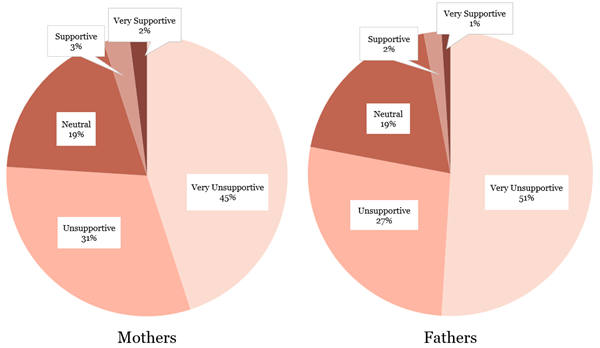
Participants reported that, when they first came out, 76% of their mothers and 78% of their fathers were either unsupportive or very unsupportive. Figure 4 shows initial rates of parental support, current levels of support will be discussed in the following section. For quantitative analysis of differences between mothers and fathers, the two supportive categories were grouped together due to the small sample size of the “very supportive” group and the two unsupportive categories were grouped together for consistency. No statistically significant differences were found between the support of mothers and fathers when the participant first came out, answering RQ1.
Parental Reasons for Rejection
Parental rejection based on the claim that it is “unnatural” to be transgender was the highest rated response with 71% of participants selecting this option. Parental fear of losing face was the second highest response at 67%. The next highest responses, coming in at nearly the same rates, were the belief that this is “just a phase” at 56%, the claim that this is the result of a negative online influence at 56%, and the fear that their child will face discrimination at 54%. This was followed by the claim that the participant has been “westernized” at 26%. Only 3% of parents rejected their child’s transgender identity on the basis of religion. These findings replicate previous studies on the trans community in China and answer RQ2 by revealing that the two main reasons for parental rejection are the claim that being transgender is “unnatural” (Lin 2018) and the fear of losing face (Song and Chen 2022).
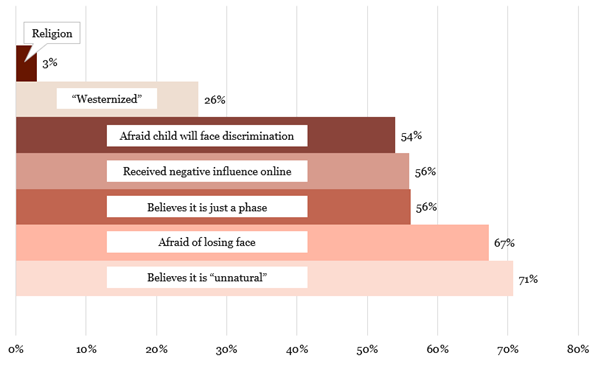
The joint display table below integrates quantitative prevalence data with qualitative lived experiences to reveal four dominant patterns in the parental rejection of transgender identities. First is sociocultural conformity as parental resistance was frequently rooted in adherence to the allegedly natural order (71%) as well as fear of social judgment (67%). Interview data exposed how these concerns reflected deeper anxieties about deviating from gendered expectations and familial norms as parents feared backlash from their social circles. The second pattern was developmental dismissiveness where 56% of parents believed the participant would grow out of their transgender identity. The third dominant theme was centered on moral corruption as 56% of parents reportedly believed their child received a negative influence online and an additional 26% attributed their transness to westernization. Individuals with parents in these categories shared that their parents blamed these external influences and even attempted to cut them off from communicating with others. The fourth and final theme was weaponized protection, where 54% parents rejected the participant’s identity on the basis that they would face a difficult life full of discrimination. Although this concern may be sincere, it could also be interpreted as a fear tactic to enforce conformity to societal norms, as, ultimately, this fear stems from violating gendered expectations. These four themes intersect across the sample size, illustrating the complexity of this issue. Qualitative findings are discussed in greater depth below.
| Quantitative Finding | Qualitative Theme | Quote |
|---|---|---|
| 71% Unnatural | Biological essentialism | “My dad called me a pervert.” |
| 67% Afraid of losing face | Societal perceptions and gender expectations | “They said not to tell anyone else…” |
| 56% Just a phase | Dismissal of the participant | “My mom said these were ‘childish ideas.’” |
| 56% Negative influence online | Peer corruption | “My mom took away my phone, hoping I'd go back to normal.” |
| 54% Feared child will face discrimination | Protective justification | “They said, ‘Among all those trans people, there's only one Jin Xing, why take the risk?’” |
| 26% Westernized | Foreign corruption | “My dad said, ‘I should have never let you leave our hometown.’” |
Trans women and transfeminine people were also surveyed on rejection due to the expectation that they would carry on the family name. Results reveal that 42% of mothers rejected them due to this expectation, while 41% did not and 17% were already supportive. As for fathers, 57% rejected them for this reason, while 34% did not and 9% were already supportive. Hypothesis testing found that fathers were more likely than mothers to reject their transgender daughters for this reason (p = 0.01). Rejection on the basis of carrying on the family name has also been documented by other researchers in China (Song and Chen 2022; Yan et al. 2019).
In addition to these predefined options, open-ended responses uncovered an additional recurring theme as 9% of respondents stated that their parents’ rejection stemmed from concern over their child’s physical health, due either to gender-affirming surgery or hormone replacement therapy. This fear over the harms of such treatments on one’s physical body is also discussed in Pi Jun’s autobiographical essay on being a trans man in China (Jun 2010).
Reasons for parental rejection show little statistical significance between genders except for the following four groups. First, transwomen are more likely than transmen to be rejected because their parents do not want to lose face (p = 0.01). Second, transmen are more likely than trans women to be rejected because their parents claim it is “just a phase” (p = 0.02). Third and fourth, binary trans participants were more likely than nonbinary participants to be rejected because their parents do not want to lose face (p = 0.01) and because their parents were afraid that their child will face discrimination (p = 0.03).
The Coming Out Experience: Qualitative Analysis of Parental Impact
Braving parental rejection
With over 75% of both mothers and fathers initially being unsupportive of the participant’s gender identity, interviewees shared a plethora of stories that detailed this rejection. As 71% of participants reported being rejected based on the belief that being transgender is unnatural, many parents responded to their child coming out with intense insults tied to their beliefs in biological essentialism. For example, when Mingxuan, a trans woman born in 1999, came out to her mother at 14, her mother responded by calling her a pervert and claiming her brain is defective. Similarly, when Shihan, born in 2003, came out to her mother at age 12, her mother called her the Chinese slur for trans women (人妖, rén yāo). This slur is particularly derogatory as the first character (人, rén) means human while the second character (妖, yāo) means devil or demon. Other interviewees’ parents had similar sentiments and berated them for being “sick.” Yize, a trans man born in 1998, reported that after coming out to his parents, they would send him anti-trans articles that claimed to provide proof that it is unnatural to be transgender.
In accordance with societal gender expectations, 67% of participants reported that their parents rejected them because they feared they themselves would lose face due to their child’s gender identity. In these cases, they pressured the participant to adhere to their sex assigned at birth in front of any extended family and forbade them from coming out to others. Baicheng, born in 1998, explained that his parents were afraid his gender identity would spark heated discussions within their community and cause a great stir that they would not know how to handle. Other participants put forth similar explanations where their parents feared they would suffer from social isolation due to their child’s gender identity. For example, Taizhe, a trans man born in 2001, explained that both his parents and their peers were very traditional; his parents believed they would lose respect in their community if their child was seen partaking in such “deviant” behavior.
Furthermore, 56% parents initially dismissed their child’s gender identity as being “just a phase,” and thus did not truly recognize and respond to their coming out until much later. Many of these parents dismissed the participant as being immature or as simply joking with them. For example, Baicheng recalled that his mother was not angry when he came out to her at 16, and instead simply dismissed his “childish ideas.” It took several gender anxiety breakdowns for his mother to realize he was serious about this matter. Once she recognized the authenticity of his proclamation, she began to become very angry at any mention of his gender identity. Other participants echoed this narrative; their parents did not take their gender identity seriously until they had told them multiple times or began socially transitioning. On the other hand, some parents believed that this was simply a normal step in puberty and wrote their gender identity off as merely the beginning stages of gender consciousness.
Another 56% of participants reported that their parents believed they received a negative influence online from people with malicious intent. As a result, when these participants came out, their parents would restrict them from accessing the internet and communicating with others. Shihan shared that her parents isolated her from her online community after she was caught trying to take HRT from the black market at age 14. Yuhua, born in 1992, recalls the conversation she had with her parents when she came out at 28,
Yuhua: “I always felt I was born in the wrong body, ever since I was very little… I’m not comfortable with most things related to being male.”
Her mother replied: “Why do you have to think that way? There is nothing you can do now; you were born a boy.”
Her father declared: “You must have heard too much strange information; I should have never let you go so far away from our hometown.”
Yuhua was especially shocked by her father’s response as he had previously never shown any concern over her decision to leave their hometown or use the internet. Similarly, 26% of participants shared that their parents attributed their transgender identity to being “westernized.” In these cases, parents regretted sending their children to study abroad as the believed that being transgender was a purely American phenomenon.
The final reason for rejection was based on the fear that the participant would face discrimination at 54%. Participants with parents in this category reported that their parents believed their child would be discriminated against within cisgender society due to the public’s lack of familiarity with the concept of being transgender. Yuhua attempted to show her parents that trans people can be successful in life by using celebrity Jin Xing as an example, but her parents simply countered “Among all those trans people, there’s only one Jin Xing, why take the risk?” Other participants reported that their parents believed the trans community was infinitesimal and they feared their child would be forced to live in isolation with no friends or no romantic partners.
Trans women were additionally rejected due to their parents’ expectation that they would carry on the family name. Parents within this category consisted of those who were more conservative and adhered to traditional societal expectations. For example, when Shihan came out to her mother at age 12, her mother vehemently opposed her gender identity, and Shihan speculates that this is due to her adherence to tradition, saying,
My mother has a lower level of education compared to my father, and she finds it difficult to accept changes. Her thoughts are more aligned with those of oppressed women from the older generation. This is a systemic sorrow. In the past in China, women were required to bear too many domestic responsibilities without receiving the recognition they deserved. They could only place their hopes and pride in their families and children. She said to me, “You are my everything and my only hope.”
Shihan’s story illustrates the expectations many Chinese parents have for their children when they are assigned male at birth. Shihan’s mother had clearly believed her “son” would carry on the family name and thus bring her pride by having children. At present, Shihan’s mother still expects her to have children, but Shihan has yet to decide if she wants children. Shihan’s transgender identity further complicates this decision as trans women who undergo hormone replacement therapy typically become infertile.
Some parents knew their children deviated from gender norms prior to them coming out but this did not necessarily prime them for acceptance as they were vehemently opposed to this behavior. For example, Mengjie, a trans woman born in 1970, used to secretly wear her sister’s clothes whenever her family was out of the house. However, she was caught by her mother several times and, as a result, was ridiculed and beaten. Thus, it is no surprise that when Mengjie, at age 40, finally came out to her mother, she was rejected and ridiculed as being “sick.”
A few parents resorted to extreme methods to “fix” their child. Yuting, born in 1997, came out as trans to her parents at age 13. They were unsupportive, claiming that she was just temporarily confused and had received a malicious influence online. They also feared she would face discrimination and did not want to lose face. This led them to send Yuting to conversion therapy where she received an unknown “medicine” via an IV drip. After a few months of this treatment resulted in no change in her gender identity, her parents brought her back home, and, several years later, they were able to finally accept her. Once Xinlei, a trans woman born in 2002, started taking HRT, her parents contacted her doctor and attempted to bully her into revoking Xinlei’s prescription. However, the doctor did not relent and Xinlei was able to continue with her HRT treatment plan. Similarly, Taizhe was expelled from his college because his mother convinced the dean to expel him if he did not start presenting as a woman again.
The initial parental rejection experienced by the majority of participants illustrates these parents’ deep-seated fears of breaking social norms and facing societal judgment. The extreme measures some parents resorted to highlight the lengths to which parental rejection can manifest in attempts to “fix” any deviations from gender conformity. In reality, such treatment serves only to harm the individual and push them further away from their family.
Negotiating with neutral parents
Although most parents were unsupportive when their child first came out, 19% were neutral. Youran’s story serves as a prime example of a truly neutral parent. Youran, a transmasculine agender person born in 1992, came out to their father at 28 over WeChat while living in the US. Initially, Youran did not say much on that matter, and simply stated, “I want to be a boy, being a girl is too hard.” Their father did not object, he simply stated, “Being a man is also very difficult.” Following this, Youran began posting pictures of themselves dressing in masculine clothes on their social media. Eventually, Youran’s father shared that he had done some research on what it means to be transgender, but when Youran invited him to join a WeChat group chat for the parents of trans people, he declined. He also did not want to read any of the informative articles Youran sent him. Later, when Youran had to acquire his consent to begin HRT, he consented without making any negative or positive remarks. When Youran told their father they wanted to be called his son and not his daughter, their father objected, saying people would be confused on how he suddenly had a son. Youran acquiesced by asking him to use the term “child” instead, and their father agreed.
Several interviewees shared that although their parents were ultimately neutral, they occasionally would display some unsupportive behavior. For example, Junxi, a trans man born in 1993, classifies his parents as being neutral when he initially came out but also shared some of his mother’s negative reactions. First, she was shocked and sad, and tried to avoid discussing this topic with Junxi for several months. Junxi’s father was more supportive and thus helped to persuade Junxi’s mother to accept his gender identity. When Junxi came home for Spring Festival, he had a face-to-face conversation with his mother that further alleviated her fears and helped her to begin moving towards acceptance. However, Junxi shared that he still feels afraid to discuss this topic further with her and thus tries to avoid it. Similarly, Chenyang, a transfeminine genderfluid person born in 2004, also shared how their mother avoided the topic of their gender identity for several years after they came out. These examples illustrate the complexity of the situation for participants with neutral parents, as their status as neutral is not necessarily fixed and can lean in the direction of either supportive or unsupportive.
Coming out to supportive parents
Only 5% of mothers and 3% of fathers were some degree of supportive when their child first came out. In the case of Ruoyu, a trans woman born in 1998, her decision to wear skirts every day throughout kindergarten aided in preparing her parents for her eventual coming out. Despite her parents’ acceptance of this gender-nonconforming behavior, after kindergarten, Ruoyu felt pressured by society to conform to gender presentation expectations for boys and kept this appearance up until she graduated college. After graduating, she began to grow her hair out and wear make-up. At first, her mother believed this was just a new way that Ruoyu was expressing her personality, and she did not protest. Once Ruoyu began to get her nails done regularly, she decided to come out to both her parents. At this point, her parents were not entirely sure what it meant to be transgender, but they understood that Ruoyu understood herself best and thus they offered their support. The more they learned about what being transgender truly is, the more supportive her parents became. Ruoyu even came out to her extended family, and almost all of them, including her 75-year-old grandmother, fully supported her.
Journeys to Acceptance: The Evolution of Parental Support
Despite such low rates of support when initially coming out, many parents became accepting of their child’s gender identity later. Reasons for parental change in support were discussed in interviews and three prominent motivations emerged along with three key routes. The motivations include parental love, the poor mental health of the participant, and the participant’s social transition. The routes to acceptance discussed by participants were consumption of informational resources, connection with the queer community, and guidance from medical professionals.
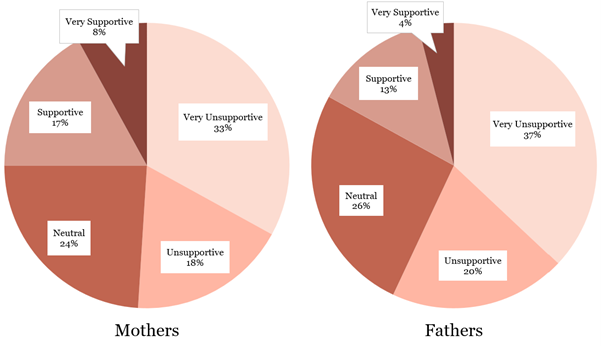
Current parental support of transgender identity was higher than expected based on previous studies of the trans population in China (K. Chan et al. 2024; Wu et al. 2017), but still remained low; as Figure 4 shows, over half of parents remain either unsupportive or very unsupportive. Forty-three percent of mothers and 34% of fathers increased their level of support after the participant came out. This was found to be statistically significant (p = 0.03) and shows that mothers are more likely to have a positive change in their support. Quantitative analysis of current rates of support also found that mothers were more likely than fathers to be supportive at this stage (p = 0.03). This provides evidence for RQ1 that mothers eventually become more accepting than fathers and replicates previous research which has found that fathers tend to be less accepting of their trans child’s gender identity than mothers (Hill and Menvielle 2009; Ishii 2017; Riggs and Due 2014; Y. Zhou et al. 2021).
Motivations Behind Parents’ Change in Support
The driving force of parental love
The first and most significant factor in gaining parental support was parental love; most interviewees in this category noted that their parents’ love for them was the main factor behind this change. Yaqi, a trans woman born in 1990, stated that while it took her parents a few years to accept her identity, she knew they would eventually support her. She stated: “My parents are, first and foremost, tolerant. They are willing to understand and accept my heart. But the key is, from the beginning, they held onto the idea of never giving up on me.” Similarly, Ruoyu recalled how, at the beginning of her transition, her parents did not fully understand her gender identity, but she states, “they respected me enough to support me.” Hongrui also reported that his parents love for him was the most important factor in gaining their support. Other interviewees reflected on the importance of parental love and mutual respect in motivating their parents to become accepting of their gender identity.
However, parents whose views changed solely out of love for their child did not necessarily understand their identity and were subsequently unable to accept the queer identity of others. Ruijuan, a transfeminine genderfluid person born in 1999, explained that their parents fall into this category because “they simply support me in being myself, relying on our good relationship.” This leads their parents to still be wary of other queer people even while being accepting of Ruijuan. Junxi also stated that his parents could not accept others being queer: “I think they may just reluctantly accept all this out of respect for my choice and love for me, but they don’t really accept these feelings.” In these cases, the parents do not truly support the trans community, rather they simply respect their child enough to have faith that they are making the right choice. The impact of love has also been documented in the American trans population where parents believe their unconditional acceptance will improve their child’s quality of life (Hill and Menvielle 2009).
Motivated by the fear of poor mental health
Many parents who saw their children experiencing intense depression and suicidal thoughts were driven to accept their child’s gender identity in the hopes of alleviating their grief. These parents also realized that forcing their child to live as their sex assigned at birth meant their child would never be happy. In many cases, these parents also acted out of fear that their children would estrange themselves: Hongrui states that eventually his parents realized that “No matter how hard they pushed me, I wouldn’t turn into the normal cisgender person they wanted me to be, and they would lose their only child.” A large portion of these parents see HRT and gender affirming surgeries as the cure to their child’s internal struggle as well as the solution to potential discrimination if they can pass as their gender identity.
Ruijuan’s parents are a prime example of this change in support due to poor mental health. When Ruijuan came out to their parents at 19, they were initially neutral in support. However, by this point, Ruijuan had been depressed for quite some time, and, prior to coming out, their parents did not understand what was causing this. Once Ruijuan’s parents realized that being forced to present as their sex assigned at birth was the major cause of this depression, they quickly became supportive of their gender identity. Ruijuan recalls,
They felt sorry for my pain and tried to find ways to make me happy. I think they were surprised by the depth of emotion I expressed about this. They were trying to understand why I feel this way. They attempted to address my gender dysphoria, and then, years later, unanimously concluded that only completing gender reassignment surgery could alleviate this severe anxiety and depressive state.
Currently, Ruijuan’s parents are very supportive of their gender identity and even helped Ruijuan undergo a vaginoplasty in the fall of 2022. With parental support and access to gender-affirming care, Ruijuan’s mental health is now better than ever.
While Ruijuan’s parents were motivated by their child’s severe depression, other parents were not spurred towards acceptance until more drastic measures were taken, such as attempted suicide. Shihan was not able to obtain any semblance of acceptance from her father until after she had attempted suicide several times and injected chemicals into her testicles to perform a self-castration. Now her father holds a neutral attitude towards her gender identity in hopes that she will not harm herself again, but her mother remains unmoved by these events. Similarly, due to their severe depression and suicidal ideation, Tingsheng, a transmasculine agender person born in 2003, stated “my parents would pretend to accept everything in order to prevent my suicide.” Research has documented other parents who were driven towards acceptance out of the fear that their child might end their life or hurt themselves, as they view it as their responsibility to prevent this (Sansfaçon et al. 2015). Previous research on the transgender community in China has also found that it takes these extreme situations of attempted suicide to convince parents to stop intervening with their children’s HRT (Amnesty International 2019).
The positive influence of transitioning
Several participants with unsupportive parents chose to begin socially and/or medically transitioning even in the face of parental rejection. As their parents observed the improvement of their mental health, they gradually began to support this change. Yaqi noted: “As they see my life getting better and happier, they have come to accept that being transgender is not a bad thing. The more I become like a girl, the more positive I become, and as my life improves, they become more relieved.” The positive change in Yaqi’s mental health led her parents to realize that being transgender was actually the answer to the problem, not the problem itself.
Transitioning in front of unsupportive parents also normalizes the concept of being trans and helps the parents to understand what life will look like for both them and their child. This, in turn, can help them move towards acceptance. Zihua, a trans man born in 2002, shared how he was able to normalize being trans by dressing in a more masculine fashion. Although his mother was initially very unsupportive, once he started presenting in line with his gender identity, she began to better understand him and would even take him shopping to buy men’s clothes. This bonding helped his mother to overcome her initial concerns, and she is now more supportive of his gender identity. Other studies have also found that the child’s transition can normalize transness to their parents and encourage acceptance (Hill and Menvielle 2009).
The Three Pathways to Acceptance
Accessing informational resources on the transgender experience
The first route to acceptance was exposure to educational and informational resources, typically via popular science articles about the transgender community. Several interviewees noted that they would share articles from researchers or medical professionals with their parents to help them better understand their trans identity. Participants also utilized blogposts and videos from other trans people to show their parents that it is possible to live a happy life as a transgender person. While previous research has documented parents who seek out this information on their own (Hill and Menvielle 2009; Johnson et al. 2020), very few participants in this study had parents with this level of initiative and the consumption of such resources was mostly driven by the participants themselves.
Connecting with the queer community
To further normalize the concept of transness, many participants connected their parents with their local queer community. The most prominent method for this involved adding their parents to a WeChat group chat that serves as a support group for the parents of transgender children. These participants noted that after joining the group chat, their parents were more understanding and began to use their new name and pronouns. Some participants noted that their parents took the initiative to connect with queer people in their daily lives. For example, Taizhe shared that his father became more accepting after meeting other queer people through his job. Similarly, Hongrui’s father used the internet to connect with the queer community and even reached out to some of his queer co-workers. The success of this method in gaining parental support further answers RQ3 and is supported by existing research on the trans community in Japan (Ishii 2017).
Sage guidance from medical professionals
Medical professionals also played a key role in influencing parents to accept their child’s gender identity. Ruoyu noted that even though her parents were relatively accepting when she came out, speaking with a psychologist helped her mother to fully support her. Her mother asked the psychologist, “Can he [sic] turn back [into a cisgender]?” The doctor replied, “A straight tree, if forced to grow at an angle, may wither and die.” After this conversation, her parents fully supported her gender identity and her medical transition. Similarly, Junxi connected his mother with his HRT doctor’s assistant, and, after the two of them talked, his mother was much more understanding and accepting of his decision to pursue HRT. The positive influence of guidance from medical professionals provides additional evidence for RQ3. Seeking reassurance and guidance from medical professionals has been documented by other researchers as a common method parents use to understand their transgender children (Gray et al. 2015; Riggs and Due 2015).
Taking multiple pathways to acceptance
Naturally, in many cases a combination of these factors was used to achieve parental acceptance. For example, Zeqing, a trans man born in 2001, had moved to the US for high school and came out to his parents at 14 when they came to visit him. At first, his parents rejected his gender identity, claiming he had been westernized, that it was just a phase, and that he was negatively influenced online. They fought non-stop for several days, with Zeqing crying himself to sleep every night. Eventually, his parents began reading articles online and talking to people at Beijing LGBT+ (北同文化, běi tóng wén huà), a queer organization in China. However, their research made them worried that Zeqing would face social rejection since the trans population seemed relatively small. Thus, they declared that Zeqing must get a diagnosis from three different doctors verifying his trans identity before he could undergo surgery. They returned to the US to attend these doctors’ meetings with Zeqing and were greatly encouraged by the plethora of information and reassurance these medical professionals provided. Once Zeqing’s parents realized that passing as his gender identity would likely protect Zeqing from certain forms of rejection and discrimination, they fully supported his transition. Zeqing notes that his ability to medically transition comes down to privilege: his parents are very wealthy and have important connections that eased the process of changing his legal gender in China.
Having multiple factors influence parental acceptance likely leads to increased success in achieving support. Baicheng recalled,
It’s possible that because my state of mind was so poor at that time, and because they love me enough and didn’t want to see me fall apart, they made some concessions. Once my condition improved, I discussed it with them properly and educated them with popular science articles about being transgender. After repeating this process dozens of times, they finally believed what I said. They also saw that I was still studying hard and realized that I wasn’t joking or being immature. They understood that the suffering I endured for so long was real and that I also had plans for the future, so they decided to comply with it.
As Baicheng’s story shows, many parents needed time and information to fully understand and accept their transgender child. This is likely due to the fact that there is little representation of transness in media and thus many Chinese parents are unfamiliar with the concept of being trans. However, this negative reaction still has a major impact on the participant; even in the face of mixed responses, negative responses have a larger impact on participants than positive ones (Johnson et al. 2020). This shows the need for increased representation of trans people in Chinese media and more easily accessible information for the parents of transgender people.
Ultimately, these findings answer RQ3 by revealing that parental love, fear over poor mental health, and the child’s transition motivate parents to shift towards accepting their gender identity. The main methods for unlocking this understanding were the consumption of informational resources, connecting with the queer community, and consulting medical professionals.
Conclusion
Through participant reported responses, this study has provided a clear understanding of how the parents of transgender people in China respond to their gender identity and what impact this has on the individual in question. While over 75% of both mothers and fathers were initially unsupportive of their child’s gender identity, a sizable portion of these parents were able to transition towards accepting and supporting their child. Unfortunately, over 50% of parents remain to be unsupportive due to their belief that being transgender is “unnatural” and their fear of losing face. Parents that did become accepting were spurred by their love for their child, concern for their child’s mental health, and their child’s efforts to normalize transness by transitioning in the face of parental rejection. Once they were motivated to move towards supporting their child, parents utilized informational resources, their local queer community, and medical professionals to educate and familiarize themselves with the reality of being transgender. Ultimately, this research illustrates the desperate need to increase transgender representation and provide readily accessible resources to the public. Doing so will aid in the normalization of transness and help prepare parents to accept gender nonconformity from anyone in their life.
Research Implications
With such high rates of parental rejection, there is a clear need to promote increased acceptance and representation for transgender people in China. Parental support can be life saving for trans people as it has been found to serve as a mitigating factor in the face of suicidal ideation (Hingston 2019; Jin et al. 2020; Simons et al. 2014). This is especially important as the rate of suicide attempts within the Chinese transgender population is exponentially higher than that of the cisgender population (Chen et al. 2019). Having the support of one’s parents can help foster the courage needed to brave society in a world where transness is not yet widely accepted. Conversely, if one’s parents act as yet another source of abuse, this exacerbates the already intense feelings of isolation and rejection. This results in the individual feeling completely alone while also leading them to believe that achieving happiness while being transgender is impossible. Thus, to improve quality of life for the transgender community, we must work to increase parental acceptance.
Increasing transgender representation in the media and spreading education on the diversity of gender identities will help to resolve these high rates of parental rejection as representation promotes acceptance (Gay & Lesbian Alliance Against Defamation 2025; Gillig et al. 2017). The most common reason for rejection found in this study, the belief that being trans is “unnatural,” stems from a lack of information on this topic. Many of the other reasons for rejection were also driven by a lack of information. The second highest reason for rejection was the parents’ fear of losing face; with increased representation and education, parents would no longer have to fear losing face in their community as the concept of being trans would become normalized. Similarly, by openly supporting their transgender child, the parents themselves are acting as an agent of social change as they show their community that being trans is socially acceptable. As those in their community are exposed to this supportive attitude for transgender people, they will also move towards accepting the queer identities of others.
Limitations
This research study is subject to various limitations due to the population and the structure of the survey questions. For the population, this survey collected data from the transgender individuals themselves, not their parents, and thus all findings are participant-reported attributions. Furthermore, upon the completion of data collection and analysis, it became evident that some additional questions and answer options should have been included in the survey. One key limitation emerged in the measurement of parental reasons for rejection; the survey did not provide a predefined option for “fear of health problems,” which 9% of participants independently reported in the open response option. Thus, the quantitative data likely underrepresents this concern as other participants may have selected this option if it were presented to them. Furthermore, the survey lacked a question to assess which factors contributed to one’s parents increasing their support of the participant’s gender identity. Although insights into this aspect were obtained through the interviews, the smaller sample size of the interview cohort restricts the reliability and generalizability of this data. Ultimately, while efforts were made to mitigate these limitations through supplementary data collection, the inherent constraints associated with sample size discrepancies and the qualitative nature of this supplementary data remain to be significant in the generalization of this study’s results.
Future Research
With these findings as a foundation, researchers should conduct similar studies using a longitudinal structure that incorporate parents as participants. Such studies will provide further evidence not only for parental reception and reasons for rejection, but also for the best routes to gain parental support. These results can then be used to inform educational programs and to equip media with positive transgender representation. Similarly, an intervention study could use an experimental structure to test different methods of obtaining acceptance and measure their impact on parental attitude by including the parents themselves as participants. This approach could potentially identify the most effective strategy for influencing one’s parent to accept their gender identity.
References
Amnesty International. May 9, 2019. “China: ‘I Need My Parents’ Consent to Be Myself’–Barriers to Gender-Affirming Treatments for Transgender People in China.” London: Amnesty International. https://www.amnesty.org/en/documents/asa17/0269/2019/en/.
Braun, Virginia, and Victoria Clarke. 2022. Thematic Analysis: A Practical Guide. Los Angeles: Sage.
Beijing LGBT+. 2023. “2021全国跨性别健康调研报告” [2021 National Transgender Health Survey Report]. Weixin QQ. https://mp.weixin.qq.com/s/HSFpurun7c2UBqXBBbYIiQ.
Central People’s Government of the People’s Republic of China 中华人民共和国中央人民政府. September 2, 2021. “国家广播电视总局办公厅关于进一步加强文艺节目及其人员管理的通知” [Notice from the General Office of the State Administration of Radio and Television on Further Strengthening the Management of Cultural Programs and Personnel]. https://www.gov.cn/zhengce/zhengceku/2021-09/02/content_5635019.htm.
Chan, Ko Ling. 2011. “Comparison of Parent and Child Reports on Child Maltreatment in a Representative Household Sample in Hong Kong.” Journal of Family Violence 27 (1): 11–21. https://doi.org/10.1007/s10896-011-9405-1.
Chan, Randolph C.H., Yiu Tung Suen, and Janice Sin Leung. 2024. “Gender Identity Differences in the Experiences of Family Stressors and Violence among Transgender and Non‐binary Individuals in China.” Family Process 63 (2): 1046–67. https://doi.org/10.1111/famp.12958.
Chen, Runsen, Xuequan Zhu, Lucy Wright, et al. 2019. “Suicidal Ideation and Attempted Suicide amongst Chinese Transgender Persons: National Population Study.” Journal of Affective Disorders 245: 1126–34. https://doi.org/10.1016/j.jad.2018.12.011.
Creswell, John W., and David Creswell. 2018. Research Design: Qualitative, Quantitative, and Mixed Methods Approaches. 5th ed. Thousand Oaks, CA: Sage.
Ministry of Education of the People’s Republic of China 中华人民共和国教育部. February 3, 2021. “培养‘阳刚之气’并无男女之分” [Cultivating Masculinity is Not About Gender]. http://www.moe.gov.cn/jyb_xwfb/s5148/202102/t20210203_512367.html.
Dong, Joy 王月眉. July 16, 2021. “金星:LGBTQ先锋人物还是性别保守派?” [Jin Xing: LGBTQ Pioneer or Gender Conservatist]. 纽约时报中文网 [The New York Times Chinese]. https://cn.nytimes.com/china/20210716/china-transgender-jin-xing/.
Dong, XinQi. 2016. “Elder Rights in China: Care for Your Parents or Suffer Public Shaming and Desecrate Your Credit Scores.” JAMA Internal Medicine 176 (10): 1429. https://doi.org/10.1001/jamainternmed.2016.5011.
Feng, Jenny. March 25, 2022. “Less Political, More Personal: The Many Struggles of China’s Transgender Population.” The China Project. https://thechinaproject.com/2022/03/25/less-political-more-personal-the-many-struggles-of-chinas-transgender-population/.
Gay & Lesbian Alliance Against Defamation. 2025. “Accelerating Acceptance 2025 Report.” GLAAD.org. https://glaad.org/accelerating-acceptance-2025/.
Gillig, Traci K., Erica L. Rosenthal, Sheila T. Murphy, and Kate Langrall Folb. 2017. “More than a Media Moment: The Influence of Televised Storylines on Viewers’ Attitudes toward Transgender People and Policies.” Sex Roles 78 (7–8): 515–27. https://doi.org/10.1007/s11199-017-0816-1.
Gray, Sarah A., Kristen K. Sweeney, Renee Randazzo, and Heidi M. Levitt. 2015. “‘Am I Doing the Right Thing?’: Pathways to Parenting a Gender Variant Child.” Family Process 55 (1): 123–38. https://doi.org/10.1111/famp.12128.
Gregor, Claire, Helen Hingley-Jones, and Sarah Davidson. 2014. “Understanding the Experience of Parents of Pre-Pubescent Children with Gender Identity Issues.” Child and Adolescent Social Work Journal 32 (3): 237–46. https://doi.org/10.1007/s10560-014-0359-z.
Gui, Tianhan. 2020. “‘Leftover Women’ or Single by Choice: Gender Role Negotiation of Single Professional Women in Contemporary China.” Journal of Family Issues 41 (11): 1956–78. https://doi.org/10.1177/0192513x20943919.
Guo, Yuling 郭毓玲. 2008. “我以我的方式孝敬父母” [I Honor my Parents in my Own Way]. 社会 [Society] 18.
Hamermesh, Daniel S, Xin Meng, and Junsen Zhang. 2002. “Dress for Success: Does Primping Pay?” Labour Economics 9 (3): 361–73. https://doi.org/10.1016/s0927-5371(02)00014-3.
Hill, Darryl B., and Edgardo Menvielle. 2009. “‘You Have to Give Them a Place Where They Feel Protected and Safe and Loved’: The Views of Parents Who Have Gender-Variant Children and Adolescents.” Journal of LGBT Youth 6 (2–3): 243–71. https://doi.org/10.1080/19361650903013527.
Hingston, Jill. 2019. “The Impact of Parental Support on the Health Behaviors of Transgender Young Adults.” PhD diss., Walden University.
Ishii, Yukari. 2017. “Rebuilding Relationships in a Transgender Family: The Stories of Parents of Japanese Transgender Children.” Journal of GLBT Family Studies 14 (3): 213–37. https://doi.org/10.1080/1550428x.2017.1326015.
Jin, Harry, Arjee Restar, William C. Goedel, Adedotun Ogunbajo, Katie Biello, Don Operario, Lisa Kuhns, Sari L. Reisner, Robert Garofalo, and Matthew J. Mimiaga. 2020. “Maternal Support Is Protective against Suicidal Ideation among a Diverse Cohort of Young Transgender Women.” LGBT Health 7 (7): 349–57. https://doi.org/10.1089/lgbt.2020.0219.
Johnson, Kelly C., Allen J. LeBlanc, Paul R. Sterzing, Julianna Deardorff, Tamar Antin, and Walter O. Bockting. 2020. “Trans Adolescents’ Perceptions and Experiences of Their Parents’ Supportive and Rejecting Behaviors.” Journal of Counseling Psychology 67 (2): 156–70. https://doi.org/10.1037/cou0000419.
Jun, Pi. 2010. “Transgender in China.” Journal of LGBT Youth 7 (4): 346–58. https://doi.org/10.1080/19361653.2010.512518.
Katz-Wise, Sabra L., Stephanie L. Budge, Ellen Fugate, et al. 2017. “Transactional Pathways of Transgender Identity Development in Transgender and Gender-Nonconforming Youth and Caregiver Perspectives from the Trans Youth Family Study.” International Journal of Transgenderism 18 (3): 243–63. https://doi.org/10.1080/15532739.2017.1304312.
Liebler, Carol M, Wei Jiang, and Li Chen. 2015. “Beauty, Binaries, and the Big Screen in China: Character Gender in Feature Films.” Asian Journal of Communication 25 (6): 584–99. https://doi.org/10.1080/01292986.2015.1019525.
Lin, Yishan 林以珊. 2018. “成年男性跨性別者的性別認同歷程與向父母現身經驗之敘事研究[Narrative Research on the Gender Identity Development Process and Coming-Out Experiences to Parents of Adult Male Transgender Individuals].” Master’s diss., Hsuan Chuang University 玄奘大學.
Liu, Yuanhang, and Xinjian Li. 2023. “‘Pale, Young, and Slim’ Girls on Red: A Study of Young Femininities on Social Media in Post-Socialist China.” Feminist Media Studies 24 (4): 744–59. https://doi.org/10.1080/14680777.2023.2226830.
Miles, Matthew B., and A. Michael Huberman. 1994a. Qualitative Data Analysis an Expanded Sourcebook. 2nd ed. Thousand Oaks, CA: Sage.
Riggs, Damien W., and Clemence Due. 2014. “Support Experiences and Attitudes of Australian Parents of Gender Variant Children.” Journal of Child and Family Studies 24 (7): 1999–2007. https://doi.org/10.1007/s10826-014-9999-z.
Sansfaçon, Annie Pullen, Marie-Joëlle Robichaud, and Audrey-Anne Dumais-Michaud. 2015. “The Experience of Parents Who Support Their Children’s Gender Variance.” Journal of LGBT Youth 12 (1): 39–63. https://doi.org/10.1080/19361653.2014.935555.
Simons, Lisa, Sheree M. Schrager, Leslie F. Clark, Marvin Belzer, and Johanna Olson. 2013. “Parental Support and Mental Health among Transgender Adolescents.” Journal of Adolescent Health 53 (6): 791–93. https://doi.org/10.1016/j.jadohealth.2013.07.019.
Song, Ge, and Christopher T. Liang. 2019. “Masculine Gender Role Expectations in China: A Consensual Qualitative Research-Modified Study.” Psychology of Men & Masculinities 20 (4): 553–63. https://doi.org/10.1037/men0000196.
Song, Youxian 宋宥賢, and Sifan Chen 陈思帆. 2022. “「在荊棘中邁向真實自我」:跨性別女性向父母現身之歷程研究” [Journeying Towards Authenticity Amidst Thorns: A Study on the Coming-Out Process of Transgender Women to Their Parents]. 國立臺灣師範大學教育心理與輔導學系教育心理學報 [National Taiwan Normal University Journal of Educational Psychology], 54 (2): 357–84.
Wang, Shuaishuai, and Hongwei Bao. 2023. “‘Sissy Capital’ and the Governance of Non-Normative Genders in China’s Platform Economy.” China Information 37 (3): 342–62. https://doi.org/10.1177/0920203x221147481.
Wu, Lijuan, Ji Qi, Ying Xin, et al. November 2017. “2017 Chinese Transgender Population General Survey Report.” China Development Brief. https://chinadevelopmentbrief.org/publications/2017-chinese-transgender-population-general-survey-report/.
Yan, Zi-Han, Jessica Lin, Wen-Jing Xiao, et al. 2019. “Identity, Stigma, and HIV Risk among Transgender Women: A Qualitative Study in Jiangsu Province, China.” Infectious Diseases of Poverty 8 (1). https://doi.org/10.1186/s40249-019-0606-9.
Yang, Mayfair Mei-hui. 1999. Spaces of Their Own: Women’s Public Sphere in Transnational China. Minneapolis: University of Minnesota Press.
Yang, Wenqi, and Fei Yan. 2017. “The Annihilation of Femininity in Mao’s China: Gender Inequality of Sent-down Youth during the Cultural Revolution.” China Information 31 (1): 63–83. https://doi.org/10.1177/0920203x17691743.
Yang, Yiqing. 2021. “The Meaning of “Filial Piety” to Older Chinese Parents.” In Aging and the Family: Understanding Changes in Structural and Relationship Dynamics, edited by Patricia Neff Claster and Sampson Lee Blair. Leeds: Emerald Publishing. https://doi.org/10.1108/S1530-353520210000017008.
Yip, Waiyee. 2021. “China: The Death of a Man Bullied for Being ‘Effeminate.’” BBC News, December 14, 2021. https://www.bbc.com/news/world-asia-china-59576108.
Zhou, Xiaogao. 2024. “Care in Transition: Global Norms, Transnational Adaptation, and Family-Centered Gender-Affirming Care in China.” Social Science and Medicine 344: 1-9. https://doi.org/10.1016/j.socscimed.2024.116658.
Zhou, Yu, Michiyo Furutani, Rukmali Athurupana, and Mikiya Nakatsuka. 2021. “Relation Between Identity Disclosure to Family Members and Mental Health in Japanese Transgender People.” Acta Medica Okayama, 75(5): 611–623. https://doi.org/10.18926/AMO/62774.