Debating Transness
A Critical Investigation into Trans Topics in Opinion Pieces
Emma Verhoeven , Rylan Verlooy
The position of trans people in news media has long been researched but much of this body of research does not consider op-eds pages. Considering the recent increase in anti-trans discourses in Europe, this study investigates how transgender issues are debated in the opinion pages of the Flemish press. Through a quantitative content analysis and a qualitative thematic analysis inspired by a Critical Frame Analysis, we uncover which themes are problematized by whom and which solutions are proposed on the opinion pages. The findings show that non-trans authors dominate the debates on trans issues and that trans-exclusionary arguments are widespread. The debates center the themes of sex and gender, freedom of speech, and discrimination and violence, sports, and health care. However, underlying these themes, the boundaries of transness are debated and defined. This way, a debate is induced on what it means to be transgender which is instigated by non-trans authors in trans-exclusionary texts.
- Volume (Issue)
- 4(4)
- Published
- December 15, 2025
- DOI
- 10.57814/x35w-9m72
- Copyright
- © 2025. The Authors. This is an open access article distributed under the terms of the Creative Commons Attribution-NonCommercial-NoDerivatives 4.0 International License (CC BY-NC-ND 4.0)
- Preferred Citation
- Verhoeven, Emma, Verlooy, Rylan. 2025. "Debating Transness: A Critical Investigation into Trans Topics in Opinion Pieces." Bulletin of Applied Transgender Studies 4 (4): 243-264. https://doi.org/10.57814/x35w-9m72
Transgender people increasingly find themselves the topic of politicized debates where their identities and rights are contested.1 This tendency also surfaced in the final weeks leading up to the federal and regional elections in Flanders in 2024. One of the talking points of the far-right Flemish-nationalist party Vlaams Belang included denying the existence of gender and wanting to scale back transgender rights (Droeven 2024). This flare up of attention for trans themes was short-lived and superficial. The spur of media attention seemed out of place, as research on Flemish news media did not previously identify transgender rights as up for debate (Verhoeven, Paulussen, and Dhoest 2023). However, in this article we investigate how, in the years leading up to these elections, the debate on trans topics has been shaped in the opinion pages, where the debate was present but remains severely understudied.
News media, and opinion pages in particular, can serve as a platform for debates surrounding transgender rights and policies (Pfannebecker and Kay 2021). Especially in current times, when anti-gender activism increasingly mobilizes on transgender rights and attempts (and sometimes succeeds) to restrict access to gender-affirming health care, unravelling these debates is relevant (Bassi and LaFleur 2022; Verloo and van der Vleuten 2020; Verlooy 2024). Many recent studies have analyzed news content about trans people and have listed ways in which journalistic coverage can be improved (e.g., Billard 2016; Capuzza 2016). However, these studies rarely discuss opinion pages (i.e., editorials, op-eds, and letters to the editor) or even exclude them (Capuzza 2016), although these pages include more trans-exclusionary discourses (Verhoeven, Paulussen, and Dhoest 2023) and include more delegitimizing language about trans people (Billard 2016) compared to editorial pages. Moreover, op-eds can have a long-lasting effect on readers’ opinions (Coppock, Ekins, and Kirby 2018). In this study, we will analyze how these discussions are shaped through a combination of thematic analysis and a quantitative content analysis.
Literature review
In interchangeably using the terms transgender and trans, we refer to Talia Mae Bettcher’s (2013) understanding of “transgender” as a broad umbrella term that brings together different gender-variant people including, but not limited to, trans men and trans women, non-binary people, and cross-dressers. The term “transgender” has been popularized in an Anglo-American institutionalized context after which it travelled to European contexts (Gill-Peterson 2024). While the term “transgender” can resonate less in a non-Western context, we use this term because the empirical material in this study is situated in a European context.
Transgender topics in journalism
Interest in trans topics has risen significantly over the past few decades (Das et al. 2023), resulting in more extensive media coverage and fewer instances of delegitimization such as deadnaming (using names from before transitioning) or misgendering (using wrong pronouns) in news articles (Olveira-Araujo 2023b). Despite this increase in trans coverage, news media tend to deploy a rigid binary conception of gender (Åkerlund 2019; Capuzza 2014). The reason we focus on journalism is its agenda-setting function (McCombs and Shaw 1972). Without wanting to overstate the media’s power on the public, it has been thoroughly demonstrated that the media serve as powerful tools to put topics on the agenda. Opinion pages provide such a platform where the focus lies on defining issues and offering solutions. A study on the discussion on LGBT topics in Spanish online-only opinion journalism found that, although transgender topics were rarely discussed, this format put LGBT topics on the agenda in 2016 in progressive outlets (Pineda, Bellido-Pérez, and Sánchez-Gutiérrez 2022).
One study on Flemish news shows that half of the news articles on trans topics feature at least one transgender source (Verhoeven, Paulussen, and Dhoest 2023). Conversely, American research reveals that approximately half of the citations in transgender news are attributed to experts, with one-third coming from transgender sources with lived experiences (Capuzza 2014). As a result, transgender people are more often talked about than doing the talking. All studies on transgender news representation conclude that trans women are overrepresented (Billard 2016; Bracco, Sczesny, and Gustafsson Sendén 2024; Capuzza 2014; Verhoeven, Paulussen, and Dhoest 2023) and that they are frequently fitted into stereotypical images of womanhood (Cavalcante 2018).
Opinion journalism provides an alternative. There, people do not function as a source but can take matters into their own hands and write about what they find important in their own words. While there is still editing and gatekeeping—journalistic actors decide whether the opinion piece is published, for example (Serino 2010)—it grants authors more agency. While these opinion pages are designed to be a public forum, evidence suggests that they are dominated by professional journalists and public figures (Ciofalo and Traverso 1994; De Smaele 2024). Research taking a gender perspective into account shows that op-eds are still predominantly written by men (Harp, Bachmann, and Loke 2014; Savage 2011). Research that focused on news articles more broadly found that journalists’ gender, conceptualized as male/female without reference to cis or trans identities, had almost no significant impact on how they covered transgender topics (Olveira-Araujo 2024). There is, to our knowledge, no research to date that considers the authorship of opinion pieces or journalism more broadly that takes into account transgender authors. Opinion journalism provides an interesting platform to study this for two reasons. First, people make their positions—including their trans identities—much more explicit in their bylines. Second, opinion journalism is not bound by the same objectivity paradigm as news journalism (Tuchman 1972), which means an author’s identity and position are more pronounced in opinion pieces. Therefore, this article aims to investigate these mechanics, and asks: Who writes opinion pieces on trans topics? (RQ1)
The themes covered in opinion pieces are equally significant, as they shape how transgender issues are publicly understood and possibly contested. Opinion pieces do not merely reflect public discourse; they also actively construct it by framing certain topics as urgent or controversial (Van Dijk 1998). Therefore, we believe it is necessary to examine in relation to which themes transgender topics receive attention in opinion pages. Quantitative analyses have shown that transgender topics are most often covered in relation to sports, representation in the media and arts, and discrimination or violence in Europe (Verhoeven, Paulussen, and Dhoest 2023) and the United States (Capuzza 2016). There seems to be an underrepresentation of transgender care and legislation (Das et al. 2023). As Billard (2016) notes, scholarship on transgender representation in the news that surpasses journalistic coverage of public figures and hate-crime victims is scarce. Dutch research shows that while general news coverage of transgender topic seems to be framed neutrally or positively, neutral attitudes are becoming less frequent as transgender themes are becoming increasingly polarized (i.e., either positive or negative; Das et al. 2023). Flemish research demonstrates that there is more room for trans-exclusionary discourse in the op-eds pages (Verhoeven, Paulussen, and Dhoest 2023). Consequently, this article asks: Which themes are covered in opinion pieces on trans topics? (RQ2)
Resistance to transgender equality
Alongside trans people and their rights, anti-trans activism, too, has become more visible in news media (Olveira-Araujo 2023a). Anti-trans activism understands gender as binary and essentialist and conceives trans women as dangerous men and trans men as confused girls. Different actors converge in anti-trans activism including far-right actors, gender essentialist academics, trans-exclusionary feminists, and Catholic actors (Bassi and LaFleur 2022; Platero 2023; Thurlow 2024). They deny the existence of trans people but target trans women differently than trans men, tapping into the racialized history of transmisogyny (Gill-Peterson 2024). Racialized trans women, non-binary people, and intersex people are rendered particularly suspicious or even dangerous for white cisgender women. These dynamics arise especially in discussions about gender-based segregated spaces like bathrooms or women’s sports which are framed as “safe spaces” for cis women. In arguing against the inclusion of trans women in sports for example, white cisgender women are portrayed as especially vulnerable when faced with the racialized Other (Pearce, Erikainen, and Vincent 2020). Sara Ahmed (2016, 26) explains how these discourses on violence flip the victim-perpetrator roles:
Thus minorities are often deemed as being violent, or as causing violence, or even as causing the violence directed against them. To give an account of trans people as causing violence (by virtue of being trans) is to cause violence against trans people.
These tendencies become even clearer when discourses revolve around children (Nash and Browne 2020; Van Wichelen, Verhoeven, and Hau 2023). Consequently, transgender health care for minors is especially contested (Olveira-Araujo 2023a).
In a different vein, actors who aim to scale back transgender rights may refrain from using overt transphobic language or targeting transgender people outright to avoid easily being labeled as transphobic. More often, these discourses take the form of understanding sex and gender as “natural” or “truthful,” whereas so-called “gender ideology” is perceived as harmful for society (Nash and Browne 2020). Much of the recent trans-exclusionary rhetoric is situated in the register of care, making trans-exclusionary actors appear benevolent, which Elster (2022) terms “insidious concern.” This benevolence is mostly granted to trans masculine persons, whose assigned female sex is emphasized to portray them as vulnerable, which perpetuates misogynistic stereotypes. On the other hand, trans feminine persons are not subjected to this register of care, and they are reimagined as predatory men. As such, this concern seems to revolve mostly around the preservation of cis and (white) womanhood.
Another way to justify transphobia is to weaponize free speech and position hate speech as a democratic right (Cammaerts 2022; Nash and Browne 2020). Trans-exclusionary actors attempt to position themselves as victims of an anti-democratic force which restricts their right to speak their mind. Contradictory to this perceived loss of free speech is the extensive and influential platforms these actors have to spread their message. Sara Ahmed (2016) reminds us that “[w]henever people keep being given a platform to say they have no platform […] you are witnessing a mechanism of power.” In this context, the ability to position oneself as a victim, and to be recognized as such, is a privilege of a position of power. As described above, mainly white cisgender women can rely on this privilege of positioning themselves as victims against the imagined danger of trans women of color. Considering these dynamics in anti-trans discourses, this article also asks: Which diagnoses and prognoses are used when discussing trans topics? (RQ3)
Case Study
We studied opinion pieces published in Flanders, the Dutch-speaking region in Belgium, a Western European country. The country’s media are divided along language, with very little interaction between French-speaking media and Dutch-speaking media. The Belgian legal framework for transgender rights is relatively extensive; trans people can change their binary sex registration based on self-determination and there are non-discrimination laws aimed to protect trans people. However, these measures do not always correspond with trans people’s lived experiences as they reflect a dominant binary man/woman understanding (Meier and Motmans 2020) and transphobia remains widespread in the Belgian population (Dierckx, Meier, and Motmans 2017; European Union Agency for Fundamental Rights 2024). This discrepancy between the legal context that portrays Belgium as a “paradise for LGBT rights” (Eeckhout and Paternotte 2011) and transphobia makes it particularly interesting to study the opinion pieces in Flemish media, as they serve as a crucial space where public attitudes toward transgender issues are shaped, challenged, or reinforced. The polarization of transgender topics in news coverage (Das et al. 2023) and the established presence of trans-exclusionary discourse in Flemish opinion pages (Verhoeven, Paulussen, and Dhoest 2023) make Flanders a particularly interesting case for examining these debates in opinion pieces.
Research has shown that trans issues are gaining traction in anti-gender mobilizations in public debates in Belgium, thereby moving away from (more marginalized) actions against abortion and LGB rights (Verlooy 2024). Anti-trans mobilizations in the country are not limited to the far right and unite a myriad of actors who employ a diverse array of platforms to spread transphobia. This tendency has been unravelling since 2017 and, as we have briefly discussed in the introduction, has surfaced in the weeks before the elections in Flanders in 2024. The far-right Flemish-nationalist party Vlaams Belang denied the existence of gender and wanted to scale back transgender rights (Droeven 2024). However, Vlaams Belang’s overt transphobia was quickly dismissed by politicians from other parties as well as journalists.
Methods
Sample
The sample of opinion articles were gathered through BelgaPress, a searchable archive of Belgian news media. We searched for opinion articles published by two Flemish newspapers (De Morgen, De Standaard) and one magazine (Knack). With this selection, we have every print medium that publishes opinion pages in Flanders, besides De Tijd—a financial newspaper that did not publish any opinion pieces about trans topics. We used a combination of search terms (see Appendix A) to gather as many opinion articles as possible, limiting the time period to the previous four years. This led to a selection of 204 articles published between 2020 and 2023, from which we manually selected the articles that covered transgender topics as the main subject (N = 87). Excluded articles mentioned trans topics in passing, for example in a listing of discrimination grounds. For the qualitative analysis, we selected a subsample of articles that represented a wide array of topics, which allowed us to investigate different lines of argumentation while keeping a fine-grained, in-depth analysis possible. In selecting these articles, we aimed to include five articles per medium per year. However, Knack did not publish enough articles every year. As such, we analyzed 15 articles from 2020 and 2021, 13 from 2022, and 12 from 2023, making for a qualitative analysis of 55 articles in total. The analyzed articles and search string are listed in Appendix A.
Quantitative Content Analysis
We applied quantitative content analysis to the full sample of 87 opinion pieces to get a descriptive overview of the authors (RQ1) and themes (RQ2). The codebook was derived inductively through collective close readings and discussions by both authors and is attached in Appendix B. Aside from metadata (medium, number of words, date, and whether it was an editorial, letter to the editor, column, or a separate opinion piece), we included a binary variable to code if the opinion piece responded to a different opinion piece.2 Regarding author, we coded the function of the author (e.g., activist, health care professional, politician) and if they were trans (no/yes).3 For these variables, we relied on the biographies provided with opinion pieces, our own extensive knowledge of Flemish media and trans actors, and information available online. If there was any doubt, we coded a person as non-trans, because trans identities were almost always made explicit. For themes, the variable included ten codes which are listed in the results in Table 2. To provide a quantitative indication for the discussion, we coded stance (trans-inclusionary/trans-exclusionary/neutral or unclear).4 In coding stance, we were aware this is a reductive understanding of the full text, but it allowed us to provide a concise overview, whereas the thematic analysis investigates the debate in-depth. We coded a text as trans-exclusionary when it excludes or denies the validity of transgender people and/or identities (Ashley 2024). Trans-inclusionary texts are those that support and/or rally for the inclusion of transgender people and/or identities.5 Each author coded half of the sample, and intercoder reliability was checked by double coding 10 articles, exceeding the commonly recommended 10% threshold. In the first round of coding, the variable for trans identity included “unknown,” which led to a discrepancy in coding between the two authors (Krippendorff’s apha .35, indicating bad intercoder reliability). This code was adapted to a binary code and authors were coded as “not trans” if there were no indications for the contrary. Krippendorff’s alpha for all variables ranged between .84 and one, indicating very good reliability (De Swert 2012). The quantitative data analysis was performed in SPSS and was limited to descriptive statistics. Because of the small sample size, we used crosstabs to show some trends in the data but refrained from making statements about significance.
Thematic Analysis
To address the three research questions on authors and themes in the opinion pages in depth, we applied a thematic analysis (Braun et al. 2019) to identify and analyze patterns (themes) in the data. This analysis was guided by the principles of Critical Frame Analysis (CFA), because of its potential to make exclusionary process visible and to expose prejudices against trans people in media (Verloo 2007). It provides a methodological framework to address different understandings of gender equality by investigating representations of the problems (diagnosis) and solutions (prognosis) for gender inequality. This structuring of diagnosis and prognosis makes explicit the logic underlying the opinion pieces. Moreover, by analyzing who suggests the problems and solutions, it allows to identify who is included or excluded in proposing problems and solutions. To achieve this, a set of sensitizing questions served as the basis to analyze a selection of opinion pieces (see Verloo, 2007, 47–49). The sensitizing questions helped us identify the proposed problems and solutions, as well as who has a voice in framing the issues. We manually coded the data and used Excel to structure the codes along the sensitizing questions.
Results
In discussing the results, we will always first discuss the most present voices, diagnoses, and solutions, making explicit whether these are trans-inclusionary or trans-exclusionary. First, we look deeper into who has a voice in opinion pieces on trans issues and is thus granted legitimacy and the power to set the agenda about these themes. Second, we report on what is problematized in the opinion pieces, the diagnosis. Third, we look at the solutions proposed by the authors, the prognosis. We discuss each of these elements for the five most prevalent themes we found, namely sex/gender, freedom of speech, discrimination and violence, sports, and health care.
Voice
The stance towards trans issues in the separate opinion pieces was predominantly trans-inclusionary (79.5% of all opinion pieces) while the columns reflected more trans-exclusionary stances (71.9% of all columns). Columnists also have the advantage of writing what they want, within the margins of what their coordinators accept, whereas loose opinion pieces need to be selected by op-eds coordinators first. Columnists are often considered to be credible sources, as they have earned a recurring column in which they share their opinions and insights every few weeks.
Journalists (28.7%) and academics (27.6%) were the most present voices in the entire sample, authoring more than half of the contributions. They were followed by activists (12.6%), and politicians (10.3%). Remaining categories, including trans people writing from lived experiences, their families or partners, or health care professionals, each accounted for less than 5% of the coverage. Table 1 lists these author categories per stance towards transgender topics. This table clearly shows that while all author categories have written trans-inclusionary articles, the trans-exclusionary articles are dominated by academics and journalists, and to a lesser extent politicians.
| Author category | Trans-inclusionary (n = 39) |
Trans-exclusionary (n = 32) |
Neutral or unclear (n = 16) |
Total |
|---|---|---|---|---|
| Journalists (n = 25) | 5 (20.5%) | 6 (25.0%) | 14 (56.3%) | 100.0% |
| Academic (n = 24) | 5 (20.8%) | 16 (66.7%) | 3 (12.5%) | 100.0% |
| Activists (n = 11) | 11 (100.0%) | 0 (0.0%) | 0 (0.0%) | 100.0% |
| Politician (n = 9) | 4 (44.4%) | 5 (55.6%) | 0 (0.0%) | 100.0% |
Speaking from own trans experience (n = 4) |
2 (50.0%) | 0 (0.0%) | 2 (50.0%) | 100.0% |
| Health care professional (n = 3) |
2 (66.7%) | 1 (33.3%) | 0 (0.0%) | 100.0% |
| Family/partner of trans person (n = 3) | 3 (100.0%) | 0 (0.0%) | 0 (0.0%) | 100.0% |
| Other (n = 8) | 4 (50.0%) | 2 (25.0%) | 2 (25.0%) | 100.0% |
Only a minority of the authors openly identify as transgender (20.7%). Almost all opinion pieces written by trans authors were trans-inclusionary, two were coded as unclear as they were mostly informative. Trans authors wrote articles on all themes (see Table 2), but they mainly had a voice to write about discrimination and violence (27.8% of all articles by trans people) and health care (16.7%). Authors who were not coded as trans focused more on debates on sex and gender, as well as freedom of speech (each making up 18.8% of all articles by non-trans people), sports (13.0%), and health care (10.1%). Trans people thus mainly have a voice in talking about personal experiences related to violence or health care. They discuss the meaning of transness related to gender and sex or can judge on trans-inclusion in sports or speech.
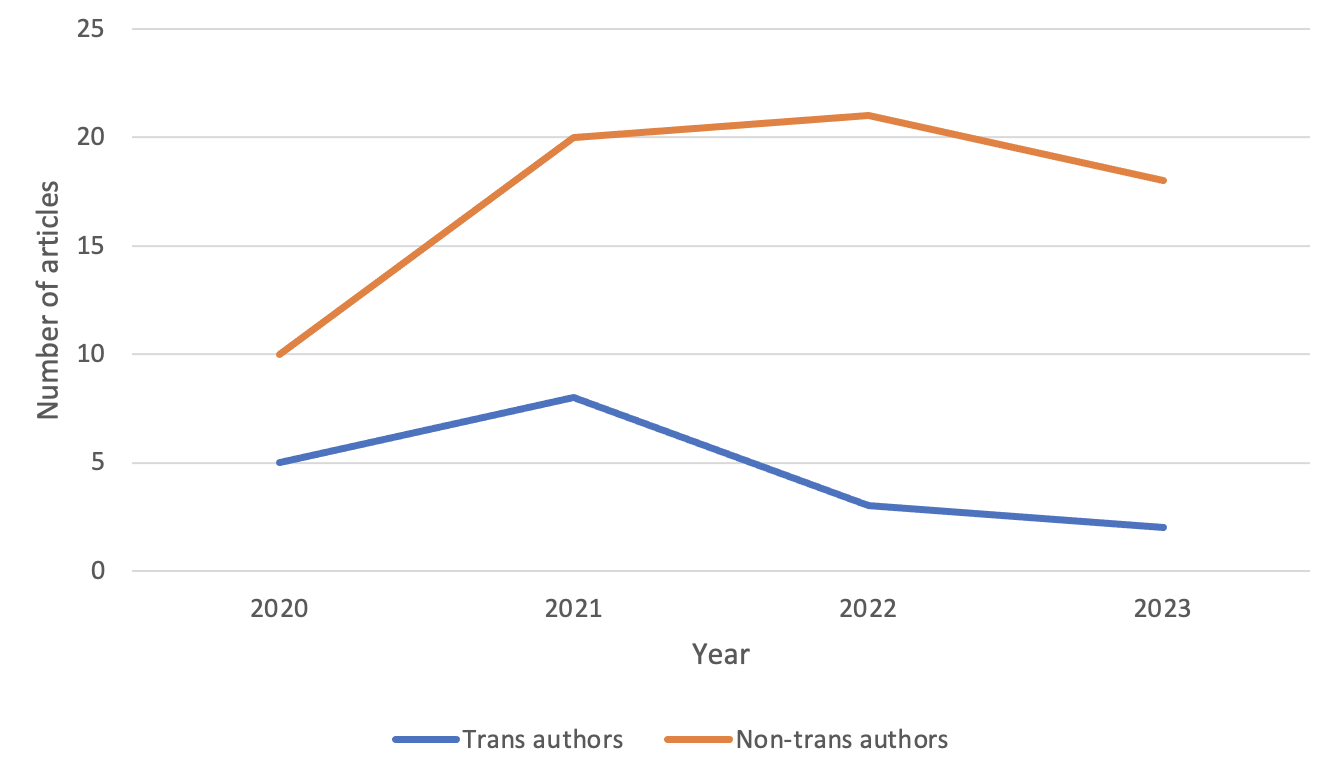
Another evolution is that the share of trans authors in the debate is diminishing, whereas non-trans authors are weighing in on these topics more (see Figure 1). While trans authors wrote 33.3% of the opinion pieces in 2020, this percentage dropped to 28.6% in 2021, 12.5% in 2022 and 10.0% in 2023. These findings are in stark contrast with research on transgender inclusion in the news in which transgender people were heard more often (Verhoeven, Paulussen, and Dhoest 2023).
Sex/gender (n = 15) |
Freedom of speech (n = 14) |
Discrimination & violence (n = 11) |
Health care (n = 10) | Sports (n = 10) |
Activism (n = 7) | Language (n = 6) | Media & culture (n = 6) |
Legislation (n = 3) | Other (n = 5) |
|
|---|---|---|---|---|---|---|---|---|---|---|
| Trans authors | 2 (13.3%) | 1 (7.1%) | 5 (45.5%) | 3 (30.0%) | 1 (10.0%) | 2 (28.6%) | 2 (33.3%) | 2 (33.3%) | 0 (0.0%) | 0.0 (0.0%) |
| Non-trans authors | 13 (86.7%) | 13 (92.9%) | 6 (54.5%) | 7 (70.0%) | 9 (90.0%) | 5 (71.4%) | 4 (66.7%) | 4 (66.7%) | 3 (100.0%) | 5 (100.0%) |
Sex/gender (n = 15) |
Freedom of speech (n = 14) |
Discrimination & violence (n = 11) |
Health care (n = 10) | Sports (n = 10) |
Activism (n = 7) | Language (n = 6) | Media & culture (n = 6) |
Legislation (n = 3) | Other (n = 5) |
|
|---|---|---|---|---|---|---|---|---|---|---|
| Trans-inclusionary | 7 (46.7%) | 3 (21.4%) | 9 (81.8%) | 4 (40.0%) | 3 (30.0%) | 4 (57.1%) | 2 (33.3%) | 4 (66.7%) | 2 (66.7%) | 1 (20.0%) |
| Trans-exclusionary | 8 (54.3%) | 8 (57.1%) | 0 (0.0%) | 5 (50.0%) | 7 (70.0%) | 2 (28.6%) | 0 (0.0%) | 0 (0.0%) | 1 (33.3%) | 1 (20.0%) |
| Neutral or unclear | 0 (0.0%) | 3 (21.4%) | 2 (18.2%) | 1 (10.0%) | 0.0 (0.0%) | 1 (14.3%) | 4 (66.7%) | 2 (33.3%) | 0.0 (0.0%) | 3 (60.0%) |
Diagnosis
The most recurring topic in the analyzed texts revolves around sex/gender debates that discuss the definitions and boundaries of both concepts. These discussions are primarily initiated by academics. Trans-exclusionary texts argue that debates on transgender issues are polarized and ruled by emotions, which they claim hinder rational conversations on the issues at stake:
[Shying away from gender theory] suggests that as a right-minded person, you are not allowed to criticize some views and practices about gender. […] People with extreme emotions rule the sex-gender debate: self-proclaimed “gender critics” who deny the existence of trans people and hypersensitive trans activists who detect transphobia everywhere. Most people avoid that minefield. (4)
They problematize the lack of nuance in discussions about trans rights, sex, and gender, and claim that what they label as extreme positions on both sides—trans-exclusionary feminists and trans activists—are undesirable. A reported consequence of the lack of debate, according to the authors, is the rising influence of trans lobbies or pharmaceutical industries who are blamed for the increase of gender dysphoria. In addition to meta-discussions about transgender debates, trans-exclusionary authors question the boundaries of trans identities. For instance, an article titled “How trans are trans teenagers?” (74) questions the trans identities of minors, suggesting that they are not actually trans but rather have been falsely made to believe they are.
In contrast, trans-inclusionary texts in the theme sex/gender debates were mostly authored by health care professionals or trans people speaking from personal experience. They critique the legitimation of theories like Rapid Onset Gender Dysphoria (ROGD) or autogynephilia in trans-exclusionary texts which are “used to discredit people […] despite the scientific rebuttal” (47). ROGD frames the increase of youth coming out as trans as an epidemic as social contagion and mental illness (Ashley 2020). The theory was widely criticized by transgender health care professionals and associations but nevertheless spread amongst trans-exclusionary academics. Similarly, autogynephilia, the hypothesis that trans women’s identities stem from sexual arousal at imagining themselves as feminine, is defended by trans-exclusionary actors.
Strongly connected to the sex/gender debates are the opinion pieces discussing freedom of speech, nearly all of which adopt a trans-exclusionary stance, save for one. Adopting similar arguments to those in the sex/gender debates, these texts argue that freedom of speech and academic freedom are under attack, as illustrated by the following excerpt:
On campuses these days, things are going quite wrong: students and professors are walking on eggshells and no longer dare to speak freely, and anyone who has an ‘uncomfortable’ opinion is silenced […] after all, they try to avoid hurting anyone to the point of absurdity. (70)
Trans-exclusionary authors argue that the increased visibility of trans people and the adoption of sensitive language to describe trans issues constitute an attack on free speech and are manifestations of cancel culture. For example, one author states:
You can hardly even talk about women anymore. It became suspicious to hold a women’s day because it is insufficiently “inclusive.” It is “transphobic” to talk about female menstruation, or to call pregnant women “mothers to be,” because there are trans men who still menstruate, or who quickly bear a child before they let themselves be transformed [sic]. (5)
These texts oppose trans-inclusive language, labeling it as “Orwellian Newspeak” (70), a dog whistle term used in conspiracy theories to signal the supposed danger of feminist and queer activism (Borba 2022; Kuhar and Paternotte 2017). The sole trans-inclusionary text of this theme reverses the roles, allocating the problem to those stirring the free speech debate, namely privileged people who already have a voice in debates (8).
A third theme in the opinion pages is homo- and transphobic discrimination and violence, a topic discussed mainly in trans-inclusionary texts. Authors frame violence against LGBTQI+ people, and especially trans people, as a structural issue rooted in cisheteronormativity, as illustrated by the following quote:
We must look at the broader, often hetero- and gender-normative context. Gender-stereotypical images and heteronormativity, in which certain masculinities and masculine behavior equal status and prestige, are an important breeding ground for homo- and transphobic violence. (9)
These texts argue that transphobia is systematically minimalized: “As trans people we are systematically pathologized [...], excluded [...], and victimized, but we are expected to keep laughing with [the transphobic comedy of] Ricky Gervais” (57). Furthermore, these texts challenge news coverage that frequently charges racialized communities with homophobic and transphobic violence, arguing that these issues are not “a monopoly of a certain ethnicity” (9, 36). One text states that the media are particularly harmful towards Female, Lesbian, Intersex, Nonbinary, Trans and Agender (FLINTA*) people. According to the author, the media add another layer of violence to the already violent cisheteronormative patriarchy: “Your sensationalist articles and your so-called neutrality […] lead to extra transphobic and sexist comments” (36).
Fourthly, the sports theme was predominantly addressed in trans-exclusionary texts, with a particular focus on trans women’s participation in women’s categories. Authors frequently argue that the inclusion of trans women unsettles the integrity of women’s sports and even threatens the safety of cisgender women, arguing that “people could die” (29). These articles explicitly accredit the cause of this problem to trans women and regard cis women as the victims: “Mediocre sportsmen merrily hijack sponsorships, scholarships, medals, and titles such as ‘sportswoman of the year’ in the ‘women’s sector’” (53). In this argument, trans women are reduced to their (male) sex assigned at birth: “These [trans] athletes may identify as women, their bodies think otherwise” (53). Remarkably, opinion pieces critiquing trans women’s participation in women’s sports were the only ones where trans women were deadnamed and misgendered. Here, transmisogyny and stereotypes regarding trans women were rampant. The authors referred to their sex assigned at birth, imposing sexist stereotypes on trans women as being violent, masculine, and threatening towards cis women.
The opinion pieces focused solely on trans women in sports, yet they never problematized trans men or non-binary people assigned female at birth. However, they did mention female intersex athletes. Despite the differences between intersex and trans experiences, opinion piece authors drew parallels between both intersex women and trans women’s participation in sports. The authors, mainly sports journalists, were profoundly focused on the women’s bodies, describing their genitals, hormones, bone structure, and chromosomes, emphasizing their “male mass, male bone-structure, and male-born power” (29). Through this focus on their bodies, trans and intersex women are portrayed as masculine, violent, and a threat for cis white womanhood. Scholars have drawn attention to how such processes of differentiation tap into the “colonial legacies that have long defined racialized women as the unfeminine or ‘masculine’ contrast to white women’s presumed ‘natural’ femininity” (Pearce, Erikainen, and Vincent 2020, 6). Trans-inclusionary texts in the sports theme were not included in the qualitative analysis because of the lack of salience of transgender specific arguments in those texts and because of their numerical minority.
The final popular theme, health care, was mainly covered from an exclusionary stance toward trans people. These texts focus on gender-affirming health care for minors. The authors first problematize the increasing prevalence of gender dysphoria: “Since a few years, the number of people with gender dysphoria has explosively grown” (66). These texts are puzzled by the rising prevalence of gender dysphoria and problematize the lack of explanation, a wonder that aligns with international trans-exclusionary actors (Ashley 2020; Billard 2023; Thurlow 2024). This text suggests some possible causes for gender dysphoria:
The strong feeling of discomfort with their sex characteristics has nothing do to with them being trans. It had different causes, that were insufficiently explored by the clinicians guiding their transition […] Autism stands out […] Anxiety and depression disorders also are prevalent in this group, besides eating-, compulsive-, and learning disorders. (31)
Next to pointing to autism and anxiety disorders as possible causes for gender dysphoria, the following quote also names social contagion as a cause of dysphoria:
Lisa Littman […] discovered that there is sometimes social contagion. The trans identification emerged in a friend group where others had outed themselves as trans. Moreover, parents reported intense use of social media before the child came out as trans. (74)
Through the frequent references to these theories, despite their rejection by several scientific communities, parallels with the discourses of transnational trans-exclusionary movements become apparent (Ashley 2020).
After suggesting possible causes of gender dysphoria, these texts problematize gender-affirming treatments in minors, especially the use of puberty blockers. One author argues that the lack of blind control-group monitored studies infringes the validity of the treatment: “Applying an insufficiently substantiated medical treatment to vulnerable children, with far-reaching and irreversible consequences, we consider irresponsible” (66). While pointing out the flaws in research to gender-affirming health care is as such not necessarily trans-exclusionary, it is a much-used argument in transnational anti-trans mobilizations (Billard 2024). Trans-exclusionary actors readily point out the lack of blinded control-group studies but omit the moral arguments against such methodologies in gender-affirming health care (Oosthoek et al. 2024). The argument evokes the “register of care” according to which trans-exclusionary actors claim to act out of benevolence while actually aiming to curb trans rights (Elster 2022).
On the other side are opinion pieces with a trans-inclusionary stance who argue that trans-exclusionary opinion pieces spread misinformation. These are often written by trans persons or their loved ones (a parent or partner) and reframe the issue: “It is a strange experience that our son’s personal trajectory is the subject of social debate” (6). They problematize the attacks on gender-affirming health care in trans-exclusionary opinion pieces. Furthermore, since these articles are a reaction to earlier trans-exclusionary texts, much of their content is aimed at debunking misinformation or highlighting misleading statistics on health care or transgender people:
[Author of 31] wrote: “A Reddit forum for detransitioners has 38.000 members.“ By doing so, she creates the impression that all those 38.000 people regret their transition. (32)
Terms such as “contagion,” “epidemy,” and “phenomena” indicate what [Author of 74]’s explanation is [for the increase in trans teens]: social contagion. “Isn’t it a bit of a trend?“ (75)
Prognosis
Similar to the diagnostic polarization on sex/gender debates, the proposed actions to address the identified problems differ considerably between trans-exclusionary and trans-inclusionary texts. Trans-exclusionary texts argue that the primary problem is the lack of rational debate on trans issues. Their proposed solution is to continue such debates. The authors urge to keep talking about the described tensions between women’s rights and trans rights which, according to the authors, are a crucial part of “the trans debate” (4, 28). One author sees more debate as a tool to find a way out of an impasse: “We need to find a compromise between [women’s] rights and trans persons’ rights” (28).
On the other hand, trans-inclusionary texts problematizing “the transgender debates” urge the opposite: to stop debates on trans people’s rights and lives. One text explicitly places the responsibility of solving the issue with actors that initiate these debates, and advocates: “It is time to question your thinking and your privileges” (9). These articles argue that the debates should cease because trans experiences are non-debatable and that transness is not a new phenomenon. Other texts emphasize the importance of positive and affirming messages for trans and non-conforming youth.
Regarding freedom of speech, where texts were all coded as trans-exclusionary except for one, the proposed solutions include continuing to debate trans topics, similar to the prognosis of sex/gender debates. The authors argue for spaces where ideas can clash and where critiquing “wokeness” or “transgender activism” is part of a healthy debate (65).
Proposed actions aimed at reducing homo- and transphobic discrimination and violence situated in trans-inclusionary texts include firstly reforming and expanding education on LGBTQI+ themes. The articles pose that educational tools should historically situate the current gender norms and diversify teaching materials: “In education […] the course content needs to be different and more inclusive” (9). Relatedly, they argue that there should be more diversity among teachers. Other authors distribute the responsibility for taking action: they call on (future) parents to accept their child’s sexuality or gender identity but also motivate queer people to organize and come together to fight against LGBTQI+-phobia and structural oppressions like racism, sexism, and ableism. Finally, authors pose that queer people should also create safe spaces for FLINTA* people to shield them from structural oppression and “cismasculine domination” (36).
The articles on the participation of trans people in sports, which mainly adopt a trans-exclusionary stance, claim that trans and intersex women’s participation in the women’s competition should be limited. At the base, they all argue for at least the reinforcement of binary sex categories, because “biological women have the right to play sports in a space reserved for them” (23). Proposed solutions include maintaining exclusive categories for cis women, opening the men’s category for everyone, installing a new “open” category, or integrating such categories within the Paralympics. Once, a text suggested to exclude all trans women from all sport categories, “to protect a very, very big majority [of cis women]” (29). These options are defended by referring to a principle of fairness, sometimes arguing that discrimination of a few to protect the majority is desirable. This author defends this solution by pointing at the numerical minority of trans women compared to cis women, stating that it entails “discrimination of some rare individuals, but it is meant to protect a large group” (12). Protecting the interests of the majority (cis women) is thus presented as a legitimation for the discrimination of the minority (trans and intersex women).
Proposed solutions for issues with gender-affirming health care, mainly put forward in trans-exclusionary texts, include the barring of puberty blockers to let gender dysphoric minors experience the puberty aligned with their sex assigned at birth:
Allowing puberty to set in is important, because in 85% [of gender dysphoric youth], gender dysphoria spontaneously disappears. Their budding sexuality will mostly lead them to discover they are not trans, but gay or lesbian. (31)
These authors point out that, for those who continue to experience gender dysphoria, medical transitions should be restricted to adulthood (66). Some authors suggest to not treat the dysphoria of the adolescents but instead “focus first and foremost on mental health care” (63), implying that mental health care is not addressed in current treatments. They assert that this will prevent people from transitioning recklessly or unnecessarily, suggesting that this is the current norm. Another author does not explicitly oppose gender-affirming health care but builds his argument around the assumption that the increase in gender dysphoria is caused by “gender ideology” (59), thereby suggesting that being transgender is a hype or trend: “Permanent doubt about your sexed character is upgraded to a new sort of being” (59). This leads the author to conclude that “liberation can also lay in accepting your body as it is,” proposing the acceptance of dysphoria as an alternative to gender-affirming health care. The authors calling to halt the use of puberty blockers urge trans health care professionals to exercise greater caution.
On the other side are trans-inclusionary texts that respond to the solutions put forward in trans-exclusionary texts. They propose more extensive support for trans and detransitioned people: “Trans teens are a vulnerable group, everyone agrees on that. What they all need is understanding, support, love, and acknowledgment” (75).
Almost all opinion pieces on health care—both inclusionary and exclusionary—argue that more research is necessary. What distinguishes them from each other is the object of this research. Trans-inclusionary pieces argue for more research into the needs of trans and detransitioned persons. One author phrases it as follows: “If more research is needed about trans teenagers, it is research that examines how that guidance is best shaped. Not this kind of manipulative propaganda packaged as scientific research” (75). Trans-exclusionary pieces, however, claim that research needs to clarify the causes of gender dysphoria and the long-term effects of gender-affirming treatments. In the meantime, these texts argue for a halt in gender-affirming care which further differentiates them from the inclusionary texts.
Discussion
In this discussion, we first want to draw attention to a more latent theme that became apparent during the analysis, namely the debating transness theme. This theme is mainly present in trans-exclusionary texts, although some inclusionary texts also touch upon it. In trans-exclusionary texts, debates on the boundaries of transness were the most vigorous in themes of sports, health care, and sex/gender. These surface-leveled themes served to induce a debate on what it means to be transgender and were instigated by non-trans authors in trans-exclusionary texts. One way transness was (de)legitimized was by presenting sex assigned at birth as a determining factor in someone’s gender identity. This resonates with findings from Anglo-Saxon contexts where anti-trans mobilizations construct sex as binary and immutable (Libby 2022; Pearce, Erikainen, and Vincent 2020; Thurlow 2024). Another way the legitimacy of a trans identity was assessed in Flemish opinion pages was by determining its causes. For example, gender dysphoria was often deemed as causing transness, but transness was only deemed legitimate when the dysphoria had been present since childhood, and when the person was neurotypical. Trans-exclusionary texts also drew from legacies of exclusion like racism, sexism, ableism, and ageism to delegitimize transness, which Hsu (2022) calls affective drift. Understanding the cause of transness and gender dysphoria is further postulated as a prerequisite for providing health care treatment. The assumption that transness is debateable becomes especially apparent in the avoidance to name gender dysphoric people “trans” but rather referring to them as “gender dysphoric youth.” This suggests that gender dysphoric youth are not considered trans nor able to determine their transness, as research from the UK has also demonstrated (Amery 2023). Moreover, their transness is pathologized and they are constructed as cis minors in need of saving (Elster 2022).
Transness is further debated in the freedom of speech theme, where questions on the validity of trans rights and identities are catalyzed by debates on freedom of speech. Here, transness serves as the object of an abstract debate which accumulates trans-exclusionary arguments. Calls for upholding debates on trans rights as part of freedom of speech then use free speech as an ideological weapon, as also noted by Ahmed (2016). They position trans identities as up for debate and represent transphobia as a defensible and responsible opinion.
While the latent debating transness theme is quite dominant in trans-exclusionary texts, it is also present in some trans-inclusionary texts which were often written in reaction to the exclusionary texts. Consequently, through the rebuttal of the arguments of trans-exclusionary texts, trans-inclusionary texts actually affirm the legitimacy of this debate. The latent theme manifested across different texts, irrespective of the coded themes. The qualitative analysis also showed that there was a lot of overlap between the different themes. Especially the theme sex/gender was present in many opinion pieces with themes such as sports, health care, and freedom of speech. These themes serve as entrance points to draw boundaries on transness in both exclusionary and inclusionary texts.
Detransitioned people and their experiences are used in inclusionary and exclusionary texts to define transness. While boundary-making in trans spaces has received some scholarly attention (Sutherland 2023), the role that detrans stories play in anti-trans mobilizations remains understudied and deserving of more (scholarly) attention, also to increase allyship between trans and detrans communities in fighting anti-trans mobilizations (Pearce, Erikainen, and Vincent 2020).
Considering the voices present in the opinion pieces, the quantitative analysis showed that only a small minority of the authors is openly transgender and that the majority of the texts takes a trans-exclusionary stance. These findings are in line with research that questions the role of opinion pages as a true public forum, as the debate is dominated by already established actors (Ciofalo and Traverso 1994; De Smaele 2024). Although research on news journalism showed that gender had little impact on how journalists cover trans topics (Olveira-Araujo 2024), these findings demonstrate the importance of including trans identities in this analysis. The imbalance of voices points to structural issues in the way debates on trans issues are currently held. The qualitative analysis showed that trans people mainly have a voice in addressing their personal experiences with (amongst others) discrimination and health care. While trans authors also have a voice in addressing issues in sports, and debates on sex/gender, they do not refrain from referring to their gendered experiences. Non-trans authors then, position themselves more as independent professionals and claim authority in discussing the relation between sex and gender, gender-affirming health care, or sports. These findings suggest that discussions on transgender issues are predominantly shaped and set on the agenda by non-trans authors. Studies on news coverage already indicated that transgender sources are often included as sources sharing personal experiences rather than as authoritative commentators and that they are drowned out by other sources (Capuzza 2014; Verhoeven, Paulussen, and Dhoest 2023). This pattern is even more pronounced in opinion pages. This raises questions about the workings of opinion pages. Ideally, they should provide a space for diverse voices and informed debate, yet in practice, they often reinforce existing power dynamics.
With half of the trans-exclusionary texts in the sample originating from academic authors and a quarter from journalists, it becomes clear that the opposition to trans rights goes beyond the field of institutional politics. Rather, the debate in Flanders is dominated by columnists who enjoy a certain amount of discursive authority and capitalize on writing polemic texts. Columnists put debates on gender diversity on the agenda and thus set the tones for these debates with mainly trans-exclusionary columns. The themes they put forward do not necessarily reflect the issues that pertain to trans people (Pearce, Erikainen, and Vincent 2020). Further research is necessary to the causes and consequences of the imbalance in voices, how the imbalance is perpetuated, and who enjoys legitimacy and authority in debates on trans issues.
From the results, an imbalance between diagnoses and prognoses became apparent. Most of the analyzed texts problematized at least one issue while few texts proposed actual solutions. This is partly due to the format of the op-eds pages, which often serve as a platform to address societal issues and which favor clear, strong opinions. Inclusionary texts suggest fewer solutions and are more focused on problematizing trans-exclusionary opinion pieces.
The results further show that the proposed problems and solutions differ greatly depending on the stance of the text. While the diagnoses sometimes align (for example the lack of knowledge on gender-affirming health care), the disparity between exclusionary and inclusionary texts is most visible in the prognoses. In different trans-exclusionary opinion pieces, the proposed solution in fact harms trans people. This was especially clear in the texts on sports, where the proposed solutions were the exclusion and discrimination against athletes specifically because of their transness. Similarly in texts on health care, trans-exclusionary authors propose halting gender-affirming treatments which is not only considered harmful for trans people individually, but is also considered as harming their human rights (Ashley 2024; Horton et al. 2024; Suess Schwend 2020).
Conclusion
This article analyzed the discussions on transgender topics in opinion articles in the Flemish press through a quantitative content analysis and a qualitative thematic analysis inspired by Critical Framing Analysis. The research questions asked who wrote opinion pieces on trans topics, which themes were covered, and which arguments were used. The findings show that the themes of sex/gender, freedom of speech, discrimination and violence, health care, and sports were most discussed. We demonstrated how non-trans authors put forth themes and discussions to contest trans rights and in doing so, also debate transness as such. The identification of the meta-theme of debating transness contributes to the research to anti-trans mobilizations outside of the UK and US contexts and provides another layer of analysis of these phenomena by going beyond the analysis of actors and discourses. While this article captured the ongoing debates in the news, there is a large share of the public debate that we did not capture, for example on social media or in right-wing alternative media, where arguments are likely to be more extreme (e.g., Verhoeven 2024).
Given the parallels Flemish trans-exclusionary opinion pieces show with international trans-exclusionary discourses, we are left to wonder what role opinion pieces play in transnational anti-trans mobilizations. From our analysis, it became clear that non-trans authors have the upper hand in framing discussions on transgender topics. It appears that opinion pieces play an important role in spreading trans-exclusionary discourses but are rarely included in research. Therefore, to further investigate how opinion pieces contribute to the increasing presence of anti-trans activism, we urge media researchers to include opinion pieces. We also recommend researchers on anti-gender activism to include anti-trans activism. Moreover, considering that trans people rarely get a voice in the opinion pages, we strongly recommend that researchers investigate from a production perspective how the distribution of legitimacy and authority to speak about transgender topics is granted through opinion pages.
We conclude this article with the words of Sara Ahmed (2016, 31) who reminds us that
[t]ransphobia and antitrans statements should not be treated as just another viewpoint that we should be free to express at the happy table of diversity. There cannot be a dialogue when some at the table are in effect (or intent on) arguing for the elimination of others at the table. When you have “dialogue or debate” with those who wish to eliminate you from the conversation (because they do not recognize what is necessary for your survival, or because they don’t even think your existence is possible), then “dialogue and debate” becomes a technique of elimination.
References
Ahmed, Sara. 2016. “An Affinity of Hammers.” TSQ: Transgender Studies Quarterly 3 (1–2): 22–34. https://doi.org/10.1215/23289252-3334151.
Åkerlund, Mathilda. 2019. “Representations of Trans People in Swedish Newspapers.” Journalism Studies 20 (9): 1319–38. https://doi.org/10.1080/1461670X.2018.1513816.
Amery, Fran. 2023. “Protecting Children in ‘Gender Critical’ Rhetoric and Strategy: Regulating Childhood for Cisgender Outcomes.” DiGeSt 10 (2): 98–114. https://doi.org/10.21825/digest.85309.
Ashley, Florence. 2020. “A Critical Commentary on ‘Rapid-Onset Gender Dysphoria.’” The Sociological Review 68 (4): 779–99. https://doi.org/10.1177/0038026120934693.
Ashley, Florence. 2024. “Gender Self-Determination as a Medical Right.” Canadian Medical Association Journal 196 (24): E833–35. https://doi.org/10.1503/cmaj.230935.
Bassi, Serena, and Greta LaFleur. 2022. “Introduction: TERFs, Gender-Critical Movements, and Postfascist Feminisms.” TSQ: Transgender Studies Quarterly 9 (3): 311–33. https://doi.org/10.1215/23289252-9836008.
Bettcher, Talia Mae. 2013. “Trapped in the Wrong Theory: Rethinking Trans Oppression and Resistance.” Signs 39 (2): 383–406. https://doi.org/10.1086/673088.
Billard, Thomas J. 2016. “Writing in the Margins: Mainstream News Media Representations of Transgenderism.” International Journal of Communication 10: 4193–218.
Billard, Thomas J. 2023. “‘Gender-Critical’ Discourse as Disinformation: Unpacking TERF Strategies of Political Communication.” Women’s Studies in Communication 46 (2): 235–43. https://doi.org/10.1080/07491409.2023.2193545.
Billard, Thomas J. 2024. “The Politics of Transgender Health Misinformation.” Political Communication 41 (2): 344–52. https://doi.org/10.1080/10584609.2024.2303148.
Borba, Rodrigo. 2022. “Enregistering ‘Gender Ideology’: The Emergence and Circulation of a Transnational Anti-Gender Language.” Journal of Language and Sexuality 11 (1): 57–79. https://doi.org/10.1075/jls.21003.bor.
Bracco, Sofia E., Sabine Sczesny, and Marie Gustafsson Sendén. 2024. “Media Portrayals of Trans and Gender Diverse People: A Comparative Analysis of News Headlines across Europe.” Sex Roles 90: 491–507. https://doi.org/10.1007/s11199-024-01461-6.
Braun, Virginia, Victoria Clarke, Nikki Hayfield, and Gareth Terry. 2019. “Thematic Analysis.” In Handbook of Research Methods in Health Social Sciences, edited by Pranee Liamputtong, 843–60. Singapore: Springer.
Cammaerts, Bart. 2022. “The Abnormalisation of Social Justice: The ‘Anti-Woke Culture War’ Discourse in the UK.” Discourse & Society 33 (6): 730–43. https://doi.org/10.1177/09579265221095407.
Capuzza, Jamie C. 2014. “Who Defines Gender Diversity? Sourcing Routines and Representation in Mainstream U.S. News Stories about Transgenderism.” International Journal of Transgender Health 15 (3–4): 115–28. https://doi.org/10.1080/15532739.2014.946195.
Capuzza, Jamie C . 2016. “Improvements Still Needed for Transgender Coverage.” Newspaper Research Journal 37 (1): 82–94. https://doi.org/10.1177/0739532916634642.
Cavalcante, Andre. 2018. Struggling for Ordinary: Media and Transgender Belonging in Everyday Life. New York: New York University Press.
Ciofalo, Andrew, and Kim Traverso. 1994. “Does the Op-Ed Page Have a Chance to Become a Public Forum?” Newspaper Research Journal 15 (4): 51–63. ttps://doi.org/10.1177/073953299401500407.
Coppock, Alexander, Emily Ekins, and David Kirby. 2018. “The Long-Lasting Effects of Newspaper Op-Eds on Public Opinion.” Quarterly Journal of Political Science 13 (1): 59–87. https://doi.org/10.1561/100.00016112.
Das, Enny, Marion Wasserbauer, Charlie Loopuijt, Aafke Uilhoorn, Anna van der Vleuten, and Chris Verhaak. 2023. Mijn gender, wiens zorg? Onderzoek naar de toename in en veranderingen van de vraag naar transgenderzorg. Nijmegen: Radboud Universiteit.
De Smaele, Hedwig. 2024. “Diversity (or Lack Thereof) of Voices on the Opinion Pages of Flemish Quality Newspapers De Standaard and De Morgen.” Paper presented at Look Who’s Talking: Voices and Sources in the News, Brussels, December 12–13.
De Swert, Knut. 2012. Calculating Inter-Coder Reliability in Media Content Analysis Using Krippendorff’s Alpha. Unpublished manuscript, University of Amsterdam. https://www.polcomm.org/wp-content/uploads/ICR01022012.pdf.
Dierckx, Myrthe, Petra Meier, and Joz Motmans. 2017. “‘Beyond the Box’: A Comprehensive Study of Sexist, Homophobic, and Transphobic Attitudes among the Belgian Population.” DiGeSt 4 (1): 5–34. https://doi.org/10.11116/digest.4.1.1.
Droeven, Valerie. 2024. “Vlaams Belang wil verworven lgbti-rechten terugdraaien: ‘Een kind heeft recht op een mama en papa.’” De Standaard, May 30. https://www.standaard.be/cnt/dmf20240530_96371369.
Eeckhout, Bart, and David Paternotte. 2011. “A Paradise for LGBT Rights? The Paradox of Belgium.” Journal of Homosexuality 58 (8): 1058–84. https://doi.org/10.1080/00918369.2011.598414.
Elster, Mikey. 2022. “Insidious Concern: Trans Panic and the Limits of Care.” TSQ: Transgender Studies Quarterly 9 (3): 407–24. https://doi.org/10.1215/23289252-9836064.
European Union Agency for Fundamental Rights. 2024. LGBTIQ Equality at a Crossroads: Progress and Challenges. Luxembourg: EU Publications Office. https://data.europa.eu/doi/10.2811/920578.
Gill-Peterson, Jules. 2024. A Short History of Trans Misogyny. New York: Verso.
Harp, Dustin, Ingrid Bachmann, and Jaime Loke. 2014. “Where Are the Women? The Presence of Female Columnists in U.S. Opinion Pages.” Journalism & Mass Communication Quarterly 91 (2): 289–307. https://doi.org/10.1177/1077699014527457.
Horton, Cal, Ruth Pearce, Jaimie Veale, T.C. Oakes-Monger, Ken C. Pang, Annie Pullen Sansfaçon, and Sophie Quinney. 2024. “Child Rights in Trans Healthcare: A Call to Action.” International Journal of Transgender Health 25 (3): 313–20. https://doi.org/10.1080/26895269.2024.2360359.
Hsu, V. Jo. 2022. “Irreducible Damage: The Affective Drift of Race, Gender, and Disability in Anti-Trans Rhetorics.” Rhetoric Society Quarterly 52 (1): 62–77. https://doi.org/10.1080/02773945.2021.1990381.
Ivy, Veronica. 2021. “If ‘Ifs’ and ‘Buts’ Were Candy and Nuts: The Failure of Arguments against Trans and Intersex Women’s Full and Equal Inclusion in Women’s Sports.” Feminist Philosophy Quarterly 7 (2). https://doi.org/10.5206/fpq/2021.2.10726.
Kuhar, Roman, and David Paternotte. 2017. Anti-Gender Campaigns in Europe: Mobilizing against Equality. Lanham, MD: Rowman & Littlefield.
Libby, C. 2022. “Sympathy, Fear, Hate: Trans-Exclusionary Radical Feminism and Evangelical Christianity.” TSQ: Transgender Studies Quarterly 9 (3): 425–42. https://doi.org/10.1215/23289252-9836078.
McClearen, Jennifer. 2023. “‘If You Let Me Play’: Girls’ Empowerment and Transgender Exclusion in Sports.” Feminist Media Studies 23 (4): 1361–75. https://doi.org/10.1080/14680777.2022.2041697.
McCombs, Maxwell E, and Donald L Shaw. 1972. “The Agenda-Setting Function of Mass Media.” Public Opinion Quarterly 36 (2): 176–87. https://doi.org/10.1086/267990.
Meier, Petra, and Joz Motmans. 2020. “Trans Laws and Constitutional Rulings in Belgium: The Ambiguous Relations between Sex and Gender.” Politics and Governance 8 (3): 242–52. https://doi.org/10.17645/pag.v8i3.2851.
Nash, Catherine Jean, and Kath Browne. 2020. Heteroactivism: Resisting Lesbian, Gay, Bisexual and Trans Rights and Equalities. London: Zed.
Olveira-Araujo, Rubén. 2023a. “No Longer Invisible, but Still Mistreated: Trans Minors and the Spanish Digital Press (2006–2020).” Journal of Children and Media 17 (2): 180–191. https://doi.org/10.1080/17482798.2023.2165518.
Olveira-Araujo, Rubén. 2023b. “The (r)Evolution of Transsexuality in the News Media: The Case of the Spanish Digital Press (2000–2020).” Journalism 24 (10): 2270–93. https://doi.org/10.1177/14648849221105316.
Olveira-Araujo, Rubén. 2024. “Do the Gender and Reporting Experience Make a Difference? A News Byline Analysis on Trans Issues.” Journalism & Mass Communication Quarterly. Advance online publication. https://doi.org/10.1177/10776990241246695.
Oosthoek, Ezra D., Skye Stanwich, Karl Gerritse, David Matthew Doyle, and Annelou L.C. de Vries. 2024. “Gender-Affirming Medical Treatment for Adolescents: A Critical Reflection on ‘Effective’ Treatment Outcomes.” BMC Medical Ethics 25 (154). https://doi.org/110.1186/s12910-024-01143-8.
Pape, Madeleine. 2022. “Something Old, Something New: Biofeminist Resistance to Trans Inclusion in Sport.” In Justice for Trans Athletes, edited by Ali Durham Greey and Helen Jefferson Lenskyj, 95–107. Leeds: Emerald.
Pearce, Ruth, Sonja Erikainen, and Ben Vincent. 2020. “TERF Wars: An Introduction.” The Sociological Review Monographs 68 (4): 677–98. https://doi.org/10.1177/0038026120934713.
Pfannebecker, Mareile, and Jilly Boyce Kay. 2021. “Trans Exclusionary Radical Centrism: The Guardian, Neoliberal Feminism and the Corbyn Years.” In Capitalism’s Conscience: 200 Years of the Guardian, edited by Des Freedman, Gary Younge, Victoria Brittain, Ghada Karmi, Hannah Hamad, Tom Mills, Natalie Fenton, Mike Berry, Matt Kennard, Mark Curtis, and Justin Schlosberg, 130–51. London: Pluto Press.
Pineda, Antonio, Elena Bellido-Pérez, and Bianca Sánchez-Gutiérrez. 2022. “Expanding Ideologies in the Press: Feminist and LGBT-Related Issues in Spanish Online-Only Opinion Journalism.” Feminist Media Studies 22 (1): 83–103. https://doi.org/10.1080/14680777.2020.1808503.
Platero, Lucas R. 2023. “Strange Bedfellows: Anti-Trans Feminists, VOX Supporters and Biologicist Academics.” DiGeSt 10 (2): 125–30. https://doi.org/10.21825/digest.89997.
Savage, Philip. 2011. “‘Sticking to Their Knitting?’ A Content Analysis of Gender in Canadian Newspaper Op-Eds.” Journal of Professional Communication 1 (1). https://doi.org/10.15173/jpc.v1i1.90.
Serino, T. Kenichi. 2010. “‘Setting the Agenda’: The Production of Opinion at the Sunday Times.” Social Dynamics 36 (1): 99–111. https://doi.org/10.1080/02533950903561312.
Suess Schwend, Amets. 2020. “Trans Health Care from a Depathologization and Human Rights Perspective.” Public Health Reviews 41 (3). https://doi.org/10.1186/s40985-020-0118-y.
Sutherland, David Kyle. 2023. “‘Trans Enough’: Examining the Boundaries of Transgender-Identity Membership.” Social Problems 70:71–86. https://doi.org/10.1093/socpro/spab031.
Thurlow, Claire. 2024. “From TERF to Gender Critical: A Telling Genealogy?” Sexualities 27 (4): 962–78. https://doi.org/10.1177/13634607221107827.
Tuchman, Gaye. 1972. “Objectivity as Strategic Ritual: An Examination of Newsmen’s Notions of Objectivity.” American Journal of Sociology 77 (4): 660–79. https://doi.org/10.1086/225193.
Van Dijk, Teun A. 1998. “Opinions and Ideologies in the Press.” In Approaches to Media Discourse, edited by Allan Bell and Peter Garrett, 21–63. Malden, MA: Blackwell.
Van Wichelen, Thalia, Emma Verhoeven, and Priscilla Hau. 2023. “The Genderbread Person: Mapping the Social Media Debate about Inclusive Sexuality Education.” Sex Education 24 (5): 585-601. https://doi.org/10.1080/14681811.2023.2238189.
Verhoeven, Emma. 2024. “Bonding over Bashing: Discussing LGBTI Topics in Far-Right Alternative News Media Comments Sections.” Communications. https://doi.org/10.1515/commun-2023-0084.
Verhoeven, Emma, Steve Paulussen, and Alexander Dhoest. 2023. “Covering Inclusion: Frames, Themes, and Voice in News about LGBTI Topics.” Journalism 25 (6): 1252–70. https://doi.org/10.1177/14648849231175216.
Verloo, Mieke, ed. 2007. Multiple Meanings of Gender Equality: A Critical Frame Analysis of Gender Policies in Europe. Budapest: Central European University Press.
Verloo, Mieke, and Anna van der Vleuten. 2020. “Trans* Politics: Current Challenges and Contstations Regarding Bodies, Recognition, and Trans* Organising.” Politics and Governance 8 (3): 223–30. https://doi.org/10.17645/pag.v8i3.3651.
Verlooy, Rylan. 2024. “Anti-Gender Mobilizations and Transgender Rights: Unpacking Recent Evolutions in Belgium.” Tijdschrift Voor Genderstudies 27 (4): 351–74. https://doi.org/10.5117/TVGN2024.4.004.VERL.
Acknowledgements
This work has received funding from the European Union’s Horizon Europe research and innovation programme under the CCINDLE project [grant agreement number 101061256]. Views and opinions expressed are those of the author(s) only and do not necessarily reflect those of the European Union or the European Research Executive Agency or UKRI. Neither the European Union nor the granting authority can be held responsible for them.
We would like to thank the three anonymous reviewers for their constructive feedback, as well as Petra Meier and Alexander Dhoest for their comments on earlier versions of this article.
The authors are listed alphabetically but would like it to be known that they should be regarded as joint first authors with equal contributions to the article.↩︎
We refer to all these texts as “opinion pieces”; “separate opinion pieces” are op-eds written by someone without (financial) attachments to the medium that are not styled as letters to the editor.↩︎
For this paper, we employed a binary coding between trans and non-trans authors. However, we do not regard the distinction between trans and non-trans as a strict binary, but rather recognize that anyone can experience discomfort with gender role expectations and affirm their gender in ways that transcend traditional understandings of masculinity and femininity.↩︎
Neutral pieces were mostly explanatory in nature (e.g., item 16 that explains which words the newspaper used). Articles were coded as unclear if they contained both inclusionary and exclusionary standpoints to not skew the data (e.g., item 81 calls for more understanding for trans teens, but consistently misgenders a non-binary student) or the stance could not be deduced clearly (e.g., item 25 is a satirical column).↩︎
See Appendix B for a more detailed operationalization of the terms trans-inclusionary and exclusionary.↩︎
Appendix A. List of articles used for analysis.
Search string (search terms separated by semicolon): genderdysfo*; “gender dysfo*”; genderidentiteit*; genderincongruent*; genderqueer*; geslachtsverander*; non-binair*; nonbinair* transfob*; transfoob; transgender*; transman*; transpersoon; transpersonen; “trans perso*”; transseks*; transvrouw*; “trans man*” “trans vrouw*”; transitie AND gender; transitie AND geslacht
All listed articles were analyzed quantitatively, those in bold were used for the critical framing analysis.
Abbreviations used:
Medium: DS = De Standaard; DM = De Morgen
Stance: N/U = neutral or unclear
| ID | Title (translated to English) | Year | Medium | Article type | Author category | Trans author | Stance | Theme | Children | |||||||||
|---|---|---|---|---|---|---|---|---|---|---|---|---|---|---|---|---|---|---|
| 1 | Let us stop the inhumane practice of ‘gay healing’ in Belgium | 2020 | Knack | Opinion piece | Politician | No | Inclusionary | Legislation | No | |||||||||
| 2 | A man in a dress is rarely a threat | 2020 | DS | Column | Journalist | No | Inclusionary | Other | No | |||||||||
| 3 | An identity is not a game of Trivial Pursuit: on the reactions to Nikkie Tutorials’ coming-out as transwoman | 2020 | DM | Opinion piece | Activist | Yes | Inclusionary | Sex/gender | No | |||||||||
| 4 | From the ideological trenches | 2020 | DS | Column | Academic | No | Exclusionary | Sex/gender | Yes | |||||||||
| 5 | Think about women’s lives, too | 2020 | DS | Column | Journalist | No | Exclusionary | Freedom of speech | No | |||||||||
| 6 | An open debate on trans rights? Unnecessary and risky | 2020 | DS | Opinion piece | Relative | No | Inclusionary | Freedom of speech | Yes | |||||||||
| 7 | Does J.K. Rowling have to watch her words? | 2020 | DS | Column | Academic | No | N/U | Freedom of speech | No | |||||||||
| 8 | J.K. Rowling, question your privileges for real now | 2020 | DS | Opinion piece | Activist | Yes | Inclusionary | Freedom of speech | No | |||||||||
| 9 | Homo- and transphobic violence is not the monopoly of a certain ethnicity | 2020 | DM | Opinion piece | Politician | No | Inclusionary | Discrimination & violence | No | |||||||||
| 10 | Genderneutral awards do not suddenly create gender equality in the film industry | 2020 | Knack | Opinion piece | Activist | Yes | Inclusionary | Media & culture | No | |||||||||
| 11 | Phobe-d | 2020 | Knack | Opinion piece | Journalist | No | N/U | Freedom of speech | No | |||||||||
| 12 | Thinking in gender boxes | 2020 | DM | Column | Journalist | No | Exclusionary | Sports | No | |||||||||
| 13 | Being non-binary is more than an X on your identity card | 2020 | Knack | Opinion piece | Activist | Yes | Inclusionary | Activism | No | |||||||||
| 14 | Excessive fuss about Sam Bettens (letter of the day) | 2020 | DM | Letter to the editor | Trans experience | Yes | N/U | Language | No | |||||||||
| 15 | It was a disastrous year for LGBTI rights | 2020 | Knack | Opinion piece | Activist | No | Inclusionary | Discrimination & violence | No | |||||||||
| 16 | Translanguage, trans language | 2021 | DS | Opinion piece | Journalist | No | N/U | Language | No | |||||||||
| 17 | Sex is not an artificial box | 2021 | DS | Column | Academic | No | Exclusionary | Sex/gender | No | |||||||||
| 18 | Transphobia in philosophy | 2021 | DS | Opinion piece | Academic | No | Exclusionary | Freedom of speech | No | |||||||||
| 19 | A left-wing transwoman who convinces right-wing men | 2021 | DS | Column | Academic | No | N/U | Activism | No | |||||||||
| 20 | Traditional distinction between man and woman is inadequate to describe complex reality | 2021 | Knack | Opinion piece | Healthcare professional | No | Inclusionary | Sex/gender | No | |||||||||
| 21 | Stating that sex is as simple as X and Y is denying science | 2021 | Knack | Opinion piece | Academic | No | Inclusionary | Sex/gender | No | |||||||||
| 22 | Who ever decided what is ‘masculine’ and ‘feminine’? | 2021 | DM | Opinion piece | Journalist | Yes | Inclusionary | Sex/gender | No | |||||||||
| 23 | Wrestling with transwomen in sports | 2021 | DS | Column | Academic | No | Exclusionary | Sports | No | |||||||||
| 24 | Dear Herman Brusselmans | 2021 | DM | Editorial | Journalist | No | N/U | Language | No | |||||||||
| 25 | An attempt at an inclusive column that hurts no one | 2021 | DS | Column | Other | No | N/U | Freedom of speech | No | |||||||||
| 26 | Sexual orientation and gender identity are facts, not trends | 2021 | Knack | Opinion piece | Activist | Yes | Inclusionary | Discrimination & violence | No | |||||||||
| 27 | Do the Games connect or do they exclude? | 2021 | DS | Opinion piece | Other | Yes | Inclusionary | Sports | No | |||||||||
| 28 | How the transgender debate is being held hostage | 2021 | DS | Column | Academic | No | Exclusionary | Freedom of speech | No | |||||||||
| 29 | Wat if a new Laurel Hubbard rises and wants to, say, go boxing? Answer: people could die | 2021 | DM | Opinion piece | Journalist | No | Exclusionary | Sports | No | |||||||||
| 30 | Men’s and women’s darts? Make it human darts | 2021 | DS | Opinion piece | Other | No | Inclusionary | Sports | No | |||||||||
| 31 | When hormones and surgery prove to be the wrong answer | 2021 | DS | Column | Academic | No | Exclusionary | Healthcare | Yes | |||||||||
| 32 | No, there is no growing group that regrets gender transition | 2021 | DS | Opinion piece | Healthcare professional | Yes | Inclusionary | Healthcare | Yes | |||||||||
| 33 | Posing critical questions about gender transition is not the same as misinformation | 2021 | DS | Letter to the editor | Other | No | Exclusionary | Healthcare | No | |||||||||
| 34 | The importance of a superhero who resembles you | 2021 | DS | Opinion piece | Trans experience | Yes | Inclusionary | Media & culture | No | |||||||||
| 35 | Fortunately, many cis men turn out to be willing to listen | 2021 | DM | Column | Journalist | No | Inclusionary | Activism | No | |||||||||
| 36 | Not everyone is welcome in Café Blond | 2021 | DS | Opinion piece | Activist | Yes | Inclusionary | Activism | No | |||||||||
| 37 | With some fear to a safe space | 2021 | DS | Column | Journalist | No | Exclusionary | Discrimination & violence | No | |||||||||
| 38 | The “indecent” comedy of Chappelle (letter of the day) | 2021 | DM | Letter to the editor | Journalist | No | Exclusionary | Media & culture | No | |||||||||
| 39 | A darling cisman | 2021 | Knack | Column | Journalist | No | Exclusionary | Other | No | |||||||||
| 40 | And now the right pronouns! | 2021 | DS | Column | Journalist | No | Inclusionary | Freedom of speech | No | |||||||||
| 41 | Bunch of cissies | 2021 | DS | Column | Journalist | No | Exclusionary | Freedom of speech | No | |||||||||
| 42 | Dave Chappelle: subtle hypocrisy through a magnifying glass | 2021 | DM | Opinion piece | Other | No | Inclusionary | Media & culture | No | |||||||||
| 43 | No doubt about it: we live in a patriarchal society | 2021 | DM | Opinion piece | Activist | Yes | Inclusionary | Discrimination & violence | No | |||||||||
| 44 | Removing sex from identity card is a good first step, but how to proceed? | 2021 | Knack | Opinion piece | Academic | No | Inclusionary | Legislation | No | |||||||||
| 45 | Everyone adjusts their language | 2021 | DS | Opinion piece | Activist | Yes | Inclusionary | Language | No | |||||||||
| 46 | Language, the precursor of reality | 2022 | DS | Opinion piece | Academic | No | Inclusionary | Language | No | |||||||||
| 47 | And then a transphobic speaker got a stage | 2022 | DS | Opinion piece | Activist | Yes | Inclusionary | Healthcare | Yes | |||||||||
| 48 | Aversion to men, you say? | 2022 | DS | Opinion piece | Other | No | Exclusionary | Media & culture | No | |||||||||
| 49 | You do not choose your sexual orientation | 2022 | DS | Column | Academic | No | Exclusionary | Sex/gender | No | |||||||||
| 50 | Men need to make room for women | 2022 | Knack | Opinion piece | Politician | Yes | Inclusionary | Discrimination & violence | No | |||||||||
| 51 | The last word: Non-binarity | 2022 | Knack | Letter to the editor | Other | No | Exclusionary | Healthcare | Yes | |||||||||
| 52 | For years, the emancipation drum has been plucked prickly, but excess leads to habituation | 2022 | Knack | Column | Politician | No | Exclusionary | Sports | No | |||||||||
| 53 | Those athletes might identify as female, their body thinks differently | 2022 | DM | Column | Politician | No | Exclusionary | Sports | No | |||||||||
| 54 | Consistently referring to transgender women as “average sportsmen” says enough about Van Doesburg’s vision on this matter | 2022 | DM | Letter to the editor | Other | No | Inclusionary | Sports | No | |||||||||
| 55 | Rainbow activism is pitting citizens against each other | 2022 | DM | Opinion piece | Academic | No | Exclusionary | Activism | No | |||||||||
| 56 | Dear Jenna Boeve | 2022 | DM | Editorial | Journalist | No | N/U | Discrimination & violence | No | |||||||||
| 57 | The transphobia of Gervais and Vandermassen | 2022 | DS | Opinion piece | Trans experience | Yes | Inclusionary | Discrimination & violence | No | |||||||||
| 58 | When extremists hijack the debate | 2022 | DS | Column | Academic | No | Exclusionary | Activism | No | |||||||||
| 59 | Has gender gone too far? | 2022 | DS | Column | Politician | No | Exclusionary | Sex/gender | Yes | |||||||||
| 60 | Help, the heterosexual nuclear family is no longer sacred | 2022 | DS | Column | Activist | No | Inclusionary | Sex/gender | No | |||||||||
| 61 | Open category | 2022 | DM | Column | Journalist | No | Exclusionary | Sports | No | |||||||||
| 62 | Man in a box, or in a skirt? | 2022 | DS | Column | Journalist | No | Inclusionary | Sex/gender | No | |||||||||
| 63 | You’re young and you want to transition | 2022 | DS | Column | Academic | No | Exclusionary | Healthcare | Yes | |||||||||
| 64 | Being honest about gender transition? Yes, please | 2022 | DS | Opinion piece | Relative | No | Inclusionary | Healthcare | Yes | |||||||||
| 65 | Weighing woke | 2022 | DM | Editorial | Journalist | No | Exclusionary | Freedom of speech | No | |||||||||
| 66 | Criticizing puberty blockers is not transphobic | 2022 | DS | Opinion piece | Healthcare professional | No | Exclusionary | Healthcare | Yes | |||||||||
| 67 | When they (“die”) can just as well be they (“hen”) | 2022 | DS | Editorial | Journalist | No | N/U | Language | No | |||||||||
| 68 | Flemish extravaganza | 2022 | DM | Column | Journalist | No | Inclusionary | Media & culture | No | |||||||||
| 69 | Wonderful things happen when you talk to each other | 2022 | DS | Column | Academic | No | N/U | Other | No | |||||||||
| 70 | Why the university should not be a “safe space” | 2023 | Knack | Opinion piece | Academic | No | Exclusionary | Freedom of speech | No | |||||||||
| 71 | Exclusion | 2023 | DM | Column | Journalist | No | Exclusionary | Sports | No | |||||||||
| 72 | Why one cancel culture is unlike the other | 2023 | DM | Editorial | Journalist | No | Exclusionary | Freedom of speech | No | |||||||||
| 73 | From transmigrant to transgender | 2023 | DM | Column | Academic | No | Inclusionary | Discrimination & violence | No | |||||||||
| 74 | How trans are trans teenagers? | 2023 | DS | Column | Academic | No | Exclusionary | Sex/gender | Yes | |||||||||
| 75 | Trans teenagers have enough problems as it is | 2023 | DS | Opinion piece | Relative | No | Inclusionary | Healthcare | Yes | |||||||||
| 76 | More surgeries, or not? | 2023 | DS | Opinion piece | Trans experience | Yes | N/U | Healthcare | No | |||||||||
| 77 | The creature previously known as woman | 2023 | DM | Column | Politician | No | Exclusionary | 7 | No | |||||||||
| 78 | I prefer the boxes of my civilization and of the West | 2023 | DM | Column | Academic | No | Exclusionary | Other | No | |||||||||
| 79 | The battle for women’s rights is not threatened by trans women | 2023 | DM | Opinion piece | Politician | Yes | Inclusionary | Discrimination & violence | No | |||||||||
| 80 | Do not forget what the rainbow flag truly symbolizes | 2023 | DM | Opinion piece | Journalist | No | Inclusionary | Discrimination & violence | No | |||||||||
| 81 | They are absent today | 2023 | Knack | Editorial | Journalist | No | N/U | Other | Yes | |||||||||
| 82 | There is definitely a problem with Evras | 2023 | DS | Column | Academic | No | Exclusionary | Legislation | Yes | |||||||||
| 83 | Gender is not cake, there is enough for everyone | 2023 | DS | Opinion piece | Academic | No | Inclusionary | Sex/gender | No | |||||||||
| 84 | We are partly bogged down in language | 2023 | DS | Column | Academic | No | Exclusionary | Sex/gender | No | |||||||||
| 85 | Without sex, you cannot define sexual orientation | 2023 | DS | Column | Academic | No | Exclusionary | Sex/gender | No | |||||||||
| 86 | Hear who knocks, children | 2023 | Knack | Column | Politician | No | Exclusionary | Freedom of speech | Yes | |||||||||
| 87 | It doesn't just work out, we have to make it work out | 2023 | DS | Opinion piece | Journalist | No | Inclusionary | Activism | No | |||||||||
Appendix B. Codebook
| V1 Item ID | Numeric |
|---|
Fill in the unique ID for the opinion piece.
| V2 Coder | Binary |
|---|
Indicate who coded the article.
0 = Author 1
1 = Author 2
| V3 Medium | Numeric |
|---|
Fill in which medium published the opinion piece.
1 = De Morgen
2 = De Standaard
3 = Knack
| V4 Date | Date |
|---|
Fill in the date.
Format: DD-MM-YYYY
| V5 Titel | String |
|---|
Copy the title in this variable.
| V6 Number of words | Numeric |
|---|
Fill in how many words the opinion piece has according to Word, including the title.
| V7 Reaction | Binary |
|---|
Does the opinion piece respond to a different opinion piece?
0 = No
1 = Yes
Krippendorff’s Alpha: 1
| V8 Theme | Numeric |
|---|
Fill in the code for the main theme of the opinion piece.
1 = healthcare
2 = discrimination and violence
3 = legislation
4 = language
5 = media and culture
6 = sports
7 = sex/gender (meta discussion on (trans)gender)
8 = activism
9 = freedom of speech, academic freedom, wokeness, cancel culture
98 = combination/unclear (was recoded by both authors together later)
99 = other
Krippendorff’s Alpha: .87
| V8b Children | Binary |
|---|
Does the opinion piece revolve around children or minors (-18)?
0 = No
1 = Yes
Krippendorff’s Alpha: 1
| V9 Stance | Numeric |
|---|
The operationalization is based on the findings from “My gender, whose care” (Das et al., 2023).
| Stance | Operationalization |
|---|---|
| 1 = trans-inclusionary | The content of the opinion piece supports and/or rallies for the inclusion of transgender people and/or identities. This also encompasses advocating for trans rights. |
| 2 = trans-exclusionary | The content of the opinion piece excludes and/or denies the validity of transgender people and/or identities. This includes exclusion from abstract categories like “womanhood”, and concrete categories like women’s sports. It furthermore refers to the pathologization, dehumanization, misgendering, and deadnaming of trans people and the opposition of their rights (Ashley, 2024; Bassi & Lafleur, 2022). |
| 3 = neither positive nor negative (recoded together with 4) | The content of the opinion piece is not unambiguously inclusionary or exclusionary of trans people and/or identities. The piece does not take a clear position, remains non-partisan, or highlights both proponents and opponents (i.e., it contains multiple stances). |
| 4 = unclear (recoded together with 3) | The stance of the opinion piece is unclear (e.g., satire). |
Krippendorff’s Alpha: 1
| V10 Trans author | Binary |
|---|
Is the article written by a trans author? Rely on the author biography, prior knowledge, the content of the opinion piece. If there are no indications an author is trans, fill in ‘0’.
0 = not trans
1 = trans
Krippendorff’s alpha first round of coding, when “unknown” was a potential code: .35
After revising and removing “unknown” code, Krippendorff’s alpha: 1
| V11 Author category | Numeric |
|---|
Indicate which author category wrote the opinion piece.
1 = interest group (recoded with 5, individual activist, because it included only one author)
2 = written from trans experience
3 = healthcare professional (academic, doctor, psychologist if related to trans topics)
4 = relative (partner, parent, sibling) of trans person
5 = activist
Only use 5 if the activist in question does not mention professional ties to healthcare (3), party politics (6), or academia (7). Only use when it applies to activism, personal (trans) stories are coded under 2.
6 = politician or in name of political party
7 = academic, not related to healthcare
8 = journalist
99 = other
Krippendorff’s alpha: .88
| V12 Article type | Numeric |
|---|
Code the article type.
1 = opinion piece
2 = editorial (written by a senior journalistic staff member)
3 = letter to the editor
4 = column
Krippendorff’s alpha: .84
| V13 Notes | String |
|---|
Space to leave notes, comments, thoughts, and questions.